World Geography Atlas › Africa › Southern Africa

South Africa

South Africa

The rainbow nation · the Cape of Good Hope.

Capital PretoriaPopulation About 63 millionArea 1,219,090 km²Language English, Zulu, and 12 in all
Map

Reading the land

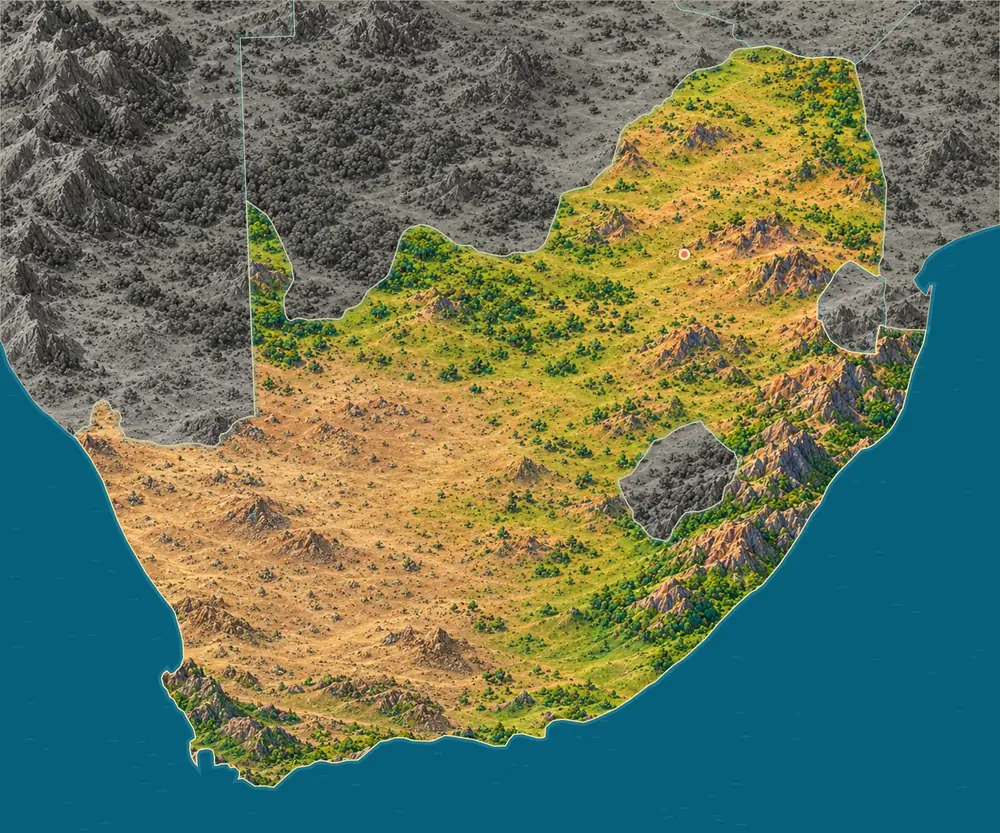
Illustrated map of South Africa
Illustrated map: yenalab. Country outlines: Natural Earth (public domain).

The middle of South Africa is high, flat land. A tall mountain chain runs along its eastern edge, and the country meets a cold sea in the west and a warm sea in the east.

In South Africa a great line of cliffs surrounds the high inland plateau, rising highest in the Drakensberg in the east. In the southern seas where the Atlantic and Indian oceans meet, a cold current and a warm current collide.

Terrain

The high plateau and the Drakensberg

The inland is high, flat land, and along its eastern edge the Drakensberg rises like an enormous wall of cliffs. Part of this range became a UNESCO World Heritage site in 2000, and in 2013 it was widened to include a park in neighbouring Lesotho.

Source: UNESCO, Maloti-Drakensberg Park
A treasure house of plants in the southwest

The Cape region at the southwestern tip covers less than 0.5% of Africa, yet nearly 20% of Africa's kinds of plants grow there. It is covered in fynbos, low shrubs with fine, tough leaves that grow back after the fires that sometimes sweep through.

Source: UNESCO, Cape Floral Region Protected Areas

Seas & currents

Geology

The oldest meteorite scar on Earth

Vredefort Dome, about 120 km southwest of Johannesburg, is part of the place where a meteorite struck about 2,023 million years ago. It is the oldest meteorite scar yet found on Earth and, with a radius of 190 km, the largest.

Source: UNESCO, Vredefort Dome

Basalt cliffs and golden sandstone

The upper Drakensberg is made of basalt, dark rock formed from cooled lava, which forms high cliffs and buttress-shaped peaks. Below it, golden sandstone layers show in tiers like castle walls.

Source: UNESCO, Maloti-Drakensberg Park
Collection

South Africa Collection

A city, a heritage site, nature, a plant, culture, food, an animal, a greeting and the flag of South Africa, each drawn as pixel art.

Pretoria
City

Pretoria

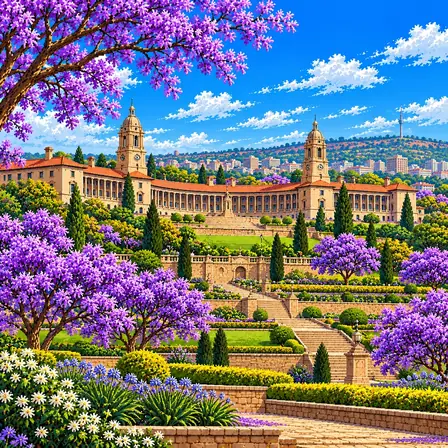
Pretoria is one of South Africa's capitals. The country has three capital cities. In spring, purple jacaranda flowers color the whole city.

Pretoria is the administrative capital of South Africa. It was built in 1855 by Boer pioneers and named after the leader Andries Pretorius. It has the Union Buildings, the president's offices, and is famous every spring when tens of thousands of jacaranda trees across the city turn purple. Along with Cape Town and Bloemfontein, it is one of the country's three capitals.

Cradle of Humankind
Heritage

Cradle of Humankind

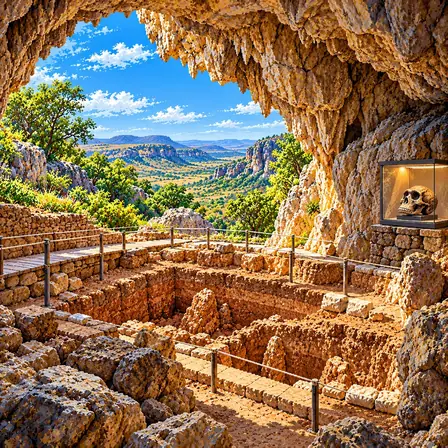
The Cradle of Humankind is an area of caves where many fossils of early human ancestors were found. Bone fossils millions of years old have been dug up there. They help us learn how people came to walk on two legs.

The Cradle of Humankind is an area of limestone cave sites near Johannesburg. In caves like Sterkfontein, many hominin fossils from about 4 million to 1 million years ago have been dug up. In 1947, the skull of an adult Australopithecus africanus was found, becoming key material for showing the origins of human upright walking. Digging is still going on today, and it became a UNESCO World Cultural Heritage site in 1999.

Kruger National Park
Nature

Kruger National Park

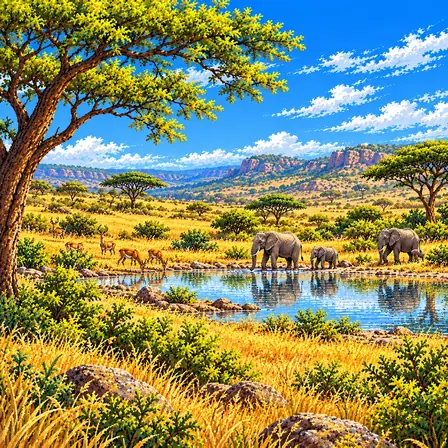
Kruger National Park is one of the largest national parks in Africa. You can see lions, elephants, rhinos, leopards and buffalo there. More than 500 kinds of birds live there too.

Kruger National Park, about 20,000 km², is one of the largest national parks in Africa. It is home to 147 kinds of mammals and 507 kinds of birds, including the "Big Five" - lion, elephant, rhino, leopard, and buffalo. Protected since 1898, it is one of Africa's oldest protected areas and has played a key role in bringing back white rhino numbers.

King Protea
Plants

King Protea

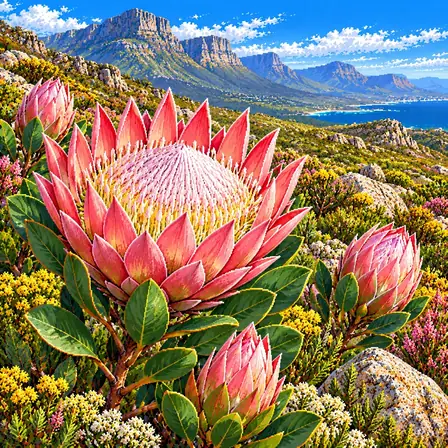
The king protea is a huge flower that looks like a crown. A single bloom can be 30 cm across. People in South Africa love it.

The king protea is a well-known flower in South Africa. Its big, showy bloom, up to 30 cm across, looks like a crown. It grows in the fynbos plant life around Cape Town, South Africa, and is a flower that stands for the country's rich plant ecosystems. The national cricket team's nickname, the Proteas, even comes from this flower.

Zulu Traditional Dress
Culture

Zulu Traditional Dress

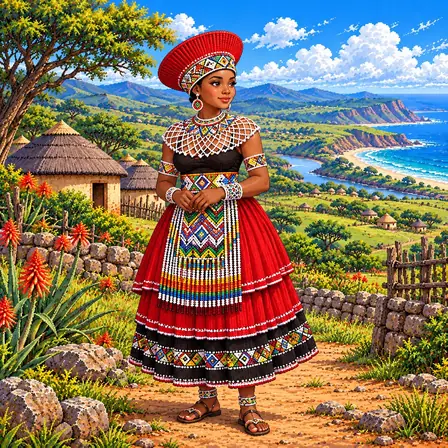
Zulu traditional dress is worn by the Zulu, the largest group of people in South Africa. Its bead necklaces and decorations are colorful. The colors and patterns of the beads can even carry messages.

Zulu traditional dress is the clothing of the Zulu people, the largest ethnic group in South Africa, with more than 10 million people. It is known for beaded necklaces, waist ornaments, and headbands, and the colors and arrangement of the beads can even carry messages of the heart. For traditional dances, white tassels are tied at the ankles and a cowhide shield is held. The indlamu dance, where dancers raise their feet high and stamp powerfully to the beat of drums, is famous. At feasts like weddings and coming-of-age ceremonies, the whole village dances together to celebrate.

Bobotie
Food

Bobotie

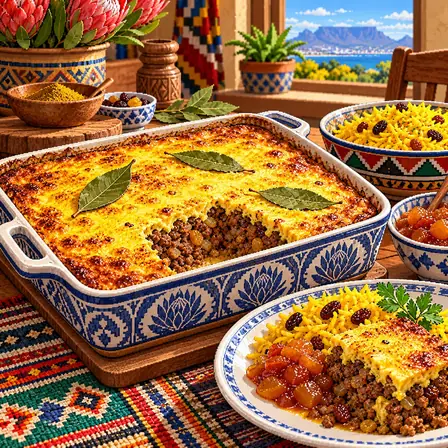
Bobotie is spiced minced meat baked with an egg topping. Raisins make it a little sweet as well as spicy. It is eaten with yellow rice.

Bobotie is a South African dish of minced meat seasoned with curry spices, topped with egg custard and baked in the oven. It grew from the food culture of Malay people who settled in the Cape region around the 17th century. Raisins or apricot jam are mixed into the meat, giving a spicy yet gently sweet taste. The egg poured on top bakes into a soft yellow layer. By tradition it is served with rice dyed yellow with turmeric and a chutney sauce.

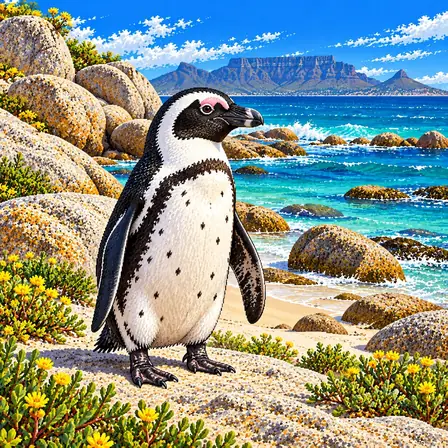
African Penguin
Animals

African Penguin

The African penguin is the only penguin that lives in Africa. It brays like a donkey. It builds its nest in the sand by the sea.

The African penguin is the only penguin that lives on the African continent. It is known for a black band on its chest and bare pink skin above the eyes, and it lets out heat through that pink skin to control its body temperature in hot weather. It makes a sound like a donkey's bray, which gives it the nickname "jackass penguin." At Boulders Beach near Cape Town, you can see a colony of penguins nesting on the sand up close. As its food, sardines, grow scarce, its numbers have dropped sharply, so it is protected as a seriously endangered species.

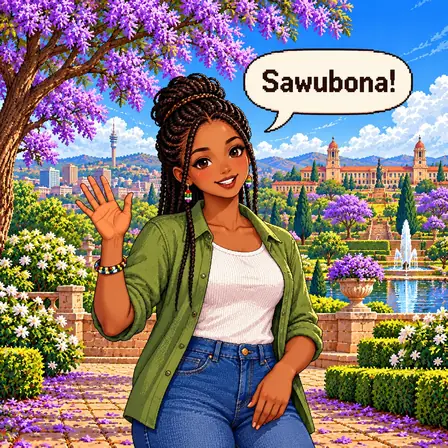
Sawubona
Greeting

Sawubona

Sawubona means "I see you" in Zulu. It shows that you see the other person as someone who matters. Zulu has special clicking sounds.

"Sawubona" is read "sa-woo-bo-na," a Zulu greeting. It means, word for word, "I see you," carrying the deep feeling of truly seeing the other person as someone precious. When you receive it, you answer "yebo" (yes, I see you). Zulu has a special sound - a click sound made like clicking the tongue - written with the letters c, q, and x. South Africa is a many-language country with 12 official languages, and Zulu has the most speakers.

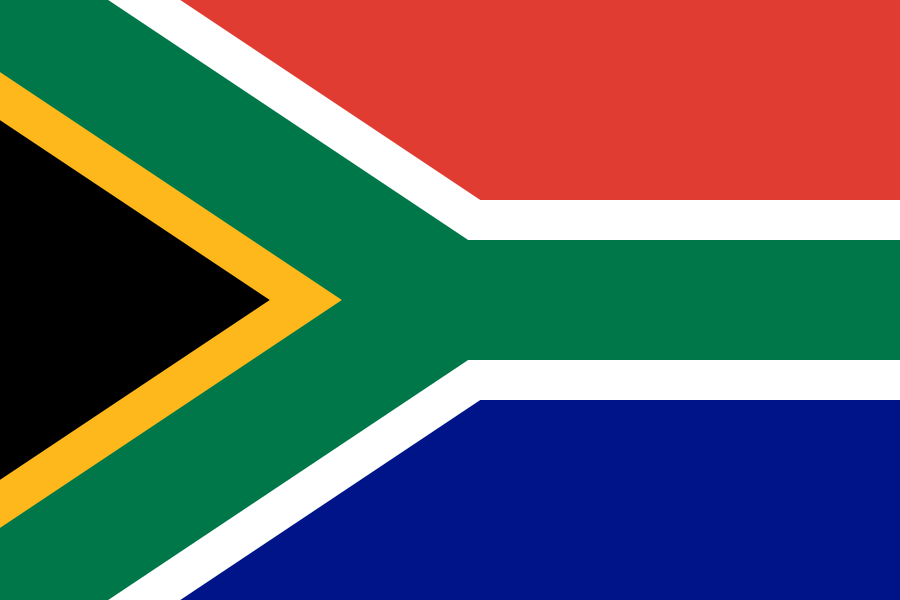
South Africa's Flag
Flag

South Africa's Flag

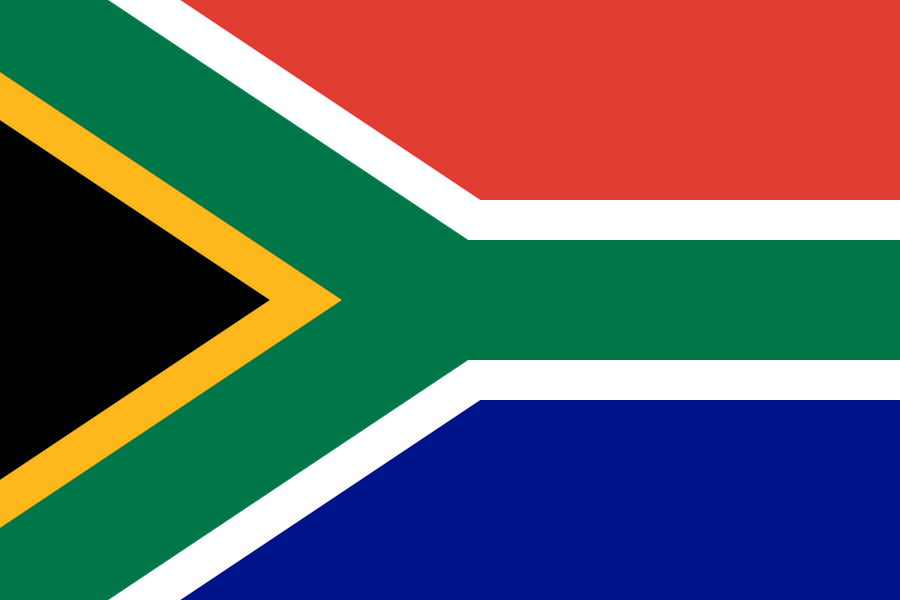
South Africa's flag has six colors. Its main shape is a sideways Y. It stands for many people moving forward together.

South Africa's flag has six colors - black, yellow, green, white, red, and blue - making it one of the most colorful flags in the world, which is rare. Its trademark is a sideways Y shape, where two paths join into one, said to mean many people moving forward together. It was adopted in 1994 as the country met a new era in which all its people take part. It fits well with the nickname "rainbow nation," for the many different people who live together like a rainbow.