Northern mountains and the Truong Son
Rugged ranges and deep valleys fill the north. The Truong Son range runs south along the western border, and high plateaus spread across the south-central region.
Source: FAO, Viet Nam country profile
World Geography Atlas › Asia › Southeast Asia
Việt Nam
An S-shaped country · pho noodles and the ao dai.
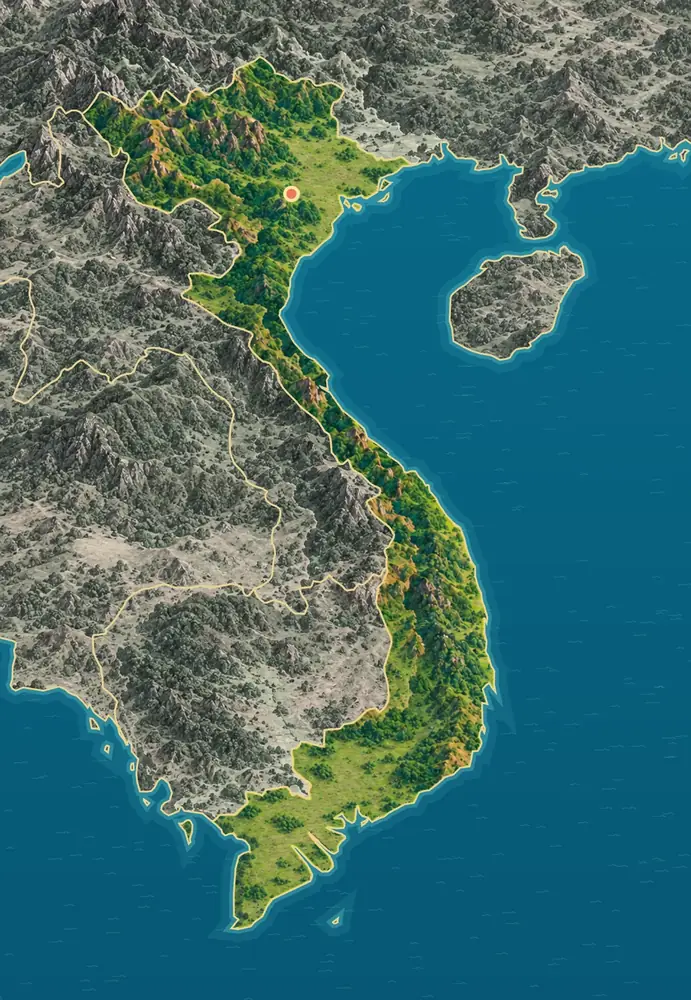
Vietnam is long and narrow, shaped like the letter S. The north is mountainous, and at the southern tip is the wide, low land made by the Mekong River.
Vietnam stretches north-south along the mainland’s eastern coast. Northern mountains, the Truong Son range in the west, narrow central coastal plains and the Red River and Mekong deltas at either end make up the country.
Rugged ranges and deep valleys fill the north. The Truong Son range runs south along the western border, and high plateaus spread across the south-central region.
Source: FAO, Viet Nam country profile
The Red River Delta around Hanoi and the Mekong Delta in the south are broad, flat lowlands. Both are covered with rice paddies.
Source: FAO, Viet Nam country profile · NASA Earth Observatory, Flooding on the Mekong River
Vietnam runs along the mainland coast from north to south. In the centre, mountains come close to the sea, leaving narrow coastal plains, while bays and headlands make the shoreline jagged.
Source: PEMSEA, National State of Oceans and Coasts: Viet Nam
The Red River and the Mekong carry soil and sand from upstream. Deposited at their mouths, it has built deltas laced with channels and wetlands.
Source: NASA Earth Observatory, Flooding on the Mekong River · FAO, Viet Nam country profile
Ha Long Bay in the northeast has more than a thousand islands and islets. Limestone, slowly dissolved by rainwater, was carved into steep peaks and caves, and the sea later flooded between them.
Old rocks are exposed in the mountains, while delta land is made of soft sediment laid down by rivers. Within one country, the land has formed in very different ways.
Source: FAO, Viet Nam country profile
A city, a heritage site, nature, a plant, culture, food, an animal, a greeting and the flag of Vietnam, each drawn as pixel art.

Hanoi is the capital of Vietnam. In the middle of the city is Hoan Kiem Lake. A little tower called the Turtle Tower stands on an island in the lake.
Hanoi is Vietnam’s capital in the northern Red River basin. Hoan Kiem Lake is a well-known place to relax in the city, and Turtle Tower stands on a small island. Old shopping streets, leafy trees and buildings from different periods surround the area. Street names in the Old Quarter preserve links to traditional trades.
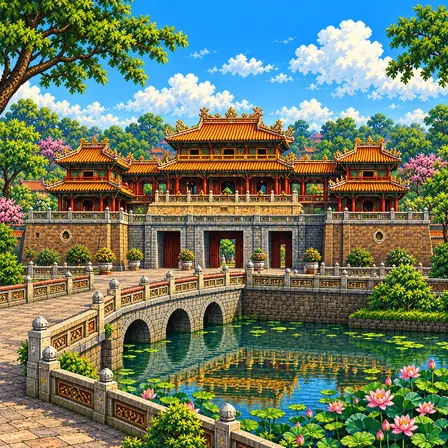
Hue's royal palace is where the kings of Vietnam's last dynasty lived. A wooden pavilion sits on top of its big stone gate. People are still repairing and caring for the damaged parts.
Huế was the Nguyễn dynasty’s capital during the nineteenth and early twentieth centuries. Its palaces, fortifications and gardens were arranged in relation to the Perfume River and surrounding hills. Ngọ Môn, the Imperial City’s Meridian Gate, has a wooden pavilion and tiled roofs above a broad masonry gateway. The Complex of Huế Monuments was listed by UNESCO in 1993, and conservation and restoration continue.

About 1,600 rocky islands rise out of the sea in Ha Long Bay. Rain and seawater carved them over a very long time. Its name means "where the dragon came down."
Ha Long Bay is a limestone karst seascape on Vietnam’s northeastern coast. Weathering and erosion have shaped the rock into steep towers and caves over a long period. Sea flooding of this landscape leaves many towers rising as islands. Their heights and shapes vary, with vegetation growing on slopes and in crevices. Ha Long Bay was listed by UNESCO in 1994; the World Heritage property now also includes the Cat Ba Archipelago.

Bougainvillea is a vine that climbs over walls. The pink parts are not petals but leaves wrapped around the flowers. Tiny white flowers hide in the middle.
Bougainvillea is a woody climbing plant that can spread across walls and doorways. The bright pink structures are bracts surrounding small flowers rather than petals themselves. Looking closely between the bracts reveals tiny white flowers. It likes sunlight and is often used to decorate houses and lanes in warm parts of Vietnam.

Ao dai means "long dress" and is Vietnam's traditional outfit. A long top that reaches the ankles is worn over wide pants. Some students wear it as a school uniform.
The ao dai, which means "long dress," is the traditional outfit of Vietnam. The long top reaches the ankles and is split up to the waist on both sides, worn over wide trousers. Its slim, modern shape was refined in the 1930s. A white ao dai worn with a palm-leaf hat called a nón lá is a scene that stands for Vietnam. Today it is worn as a wedding outfit and even as a school uniform for girls.
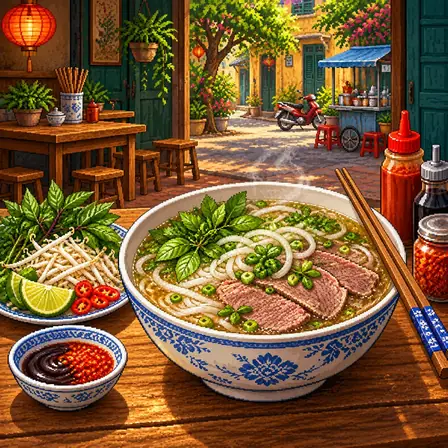
Pho is a clear meat soup with flat rice noodles. You add bean sprouts and fresh herbs and squeeze in some lime. People in Vietnam love it for breakfast.
Pho is Vietnam's best-known dish - flat rice noodles and thinly sliced beef in a clear broth made by simmering beef bones for a long time. It is said to have started in the early 20th century around Hanoi in northern Vietnam. The broth is given a gentle scent with spices like cinnamon and star anise. People pile on bean sprouts and fragrant herbs and squeeze in lime to suit their taste. In Vietnam it is a favorite breakfast, so pho shops are busy from early in the morning.
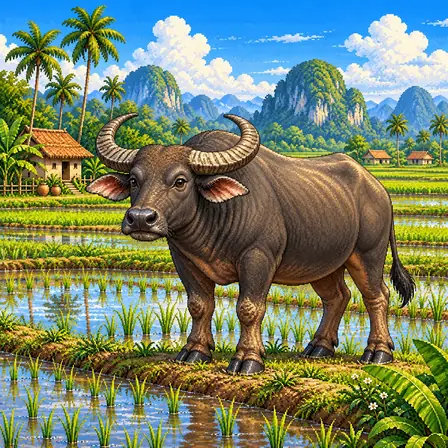
The water buffalo is a cow-like animal with big curved horns. On hot days it cools off in mud. For a long time it has helped farmers plow rice fields.
The water buffalo is a member of the cattle family with big, backward-curving horns and a dark gray body. As its name says, it loves water, cooling its body in the mud during the hot day to keep off insects. Thanks to its wide hooves, it can walk on muddy rice paddies without sinking. In the Vietnamese countryside it has helped plow wet fields and carry loads for thousands of years. Even now it is a part of the rural scene that can't be left out, an animal that stands for hard work.

Xin chào means "hello" in Vietnamese. In Vietnamese, the same sound can mean different things depending on its pitch. Little marks above the letters show the pitch.
Xin chào is a Vietnamese greeting used to say hello. In conversation, people may add forms of address suited to their relationship. Vietnamese is tonal: pitch and its changes help distinguish words. It uses Quốc Ngữ, a Latin-based writing system with diacritics. The grave mark on à in chào is a tone mark.
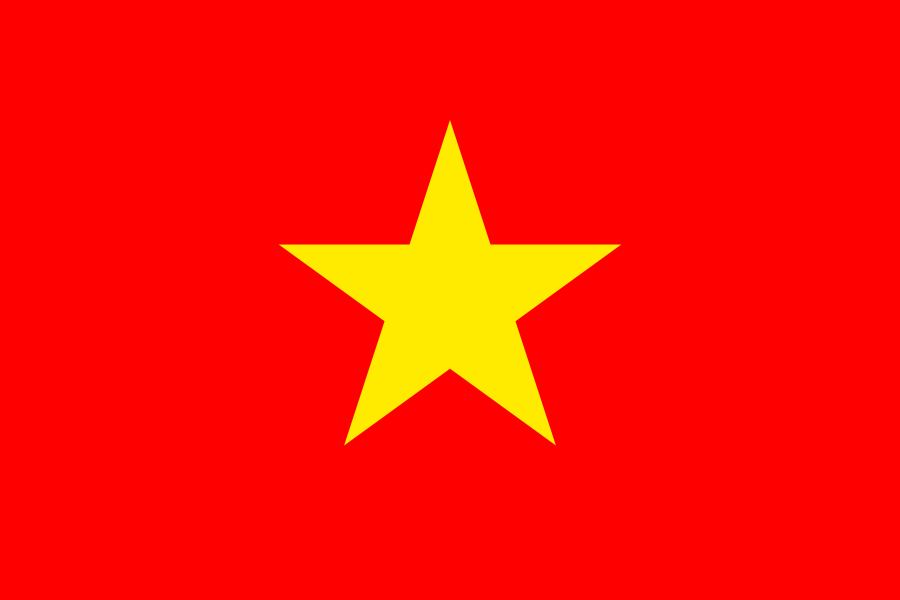
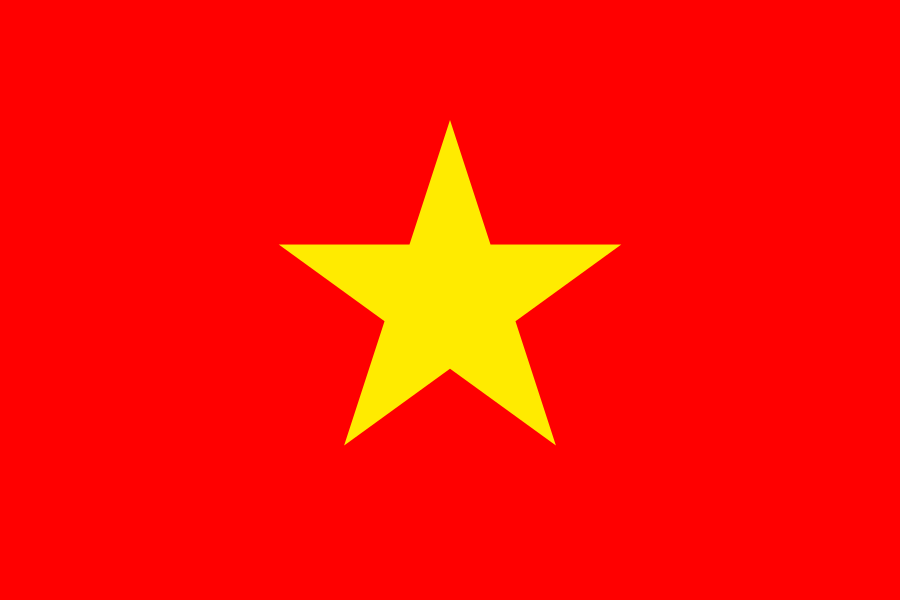
Vietnam's flag has one yellow star in the middle of a red background. It is called the "red flag with a golden star." The star's five points stand for different groups of people joined together.
Vietnam's flag has a single yellow star in the center of a red field. It is called the "red flag with a golden star." The five points of the star are said to show five groups - scholars, farmers, workers, merchants, and soldiers - joined into one. Red and yellow are colors that have long been treasured in Vietnam. It began to be used as the national flag in 1945.