World Geography Atlas › Europe › Southern Europe

Türkiye

Türkiye

A country spread across two continents · hot-air balloons and Cappadocia.

Capital AnkaraPopulation About 85 millionArea 783,562 km²Language Turkish
Map

Reading the land

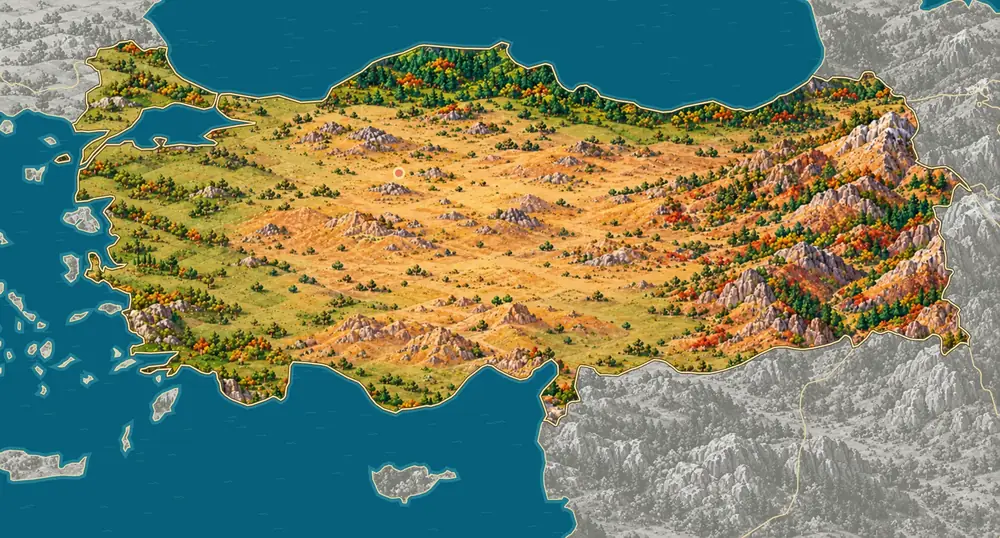
Illustrated map of Türkiye
Illustrated map: yenalab. Country outlines: Natural Earth (public domain).

Türkiye spreads across two continents, Europe and Asia. Its middle is a wide, high, flat land, and the mountains get higher toward the east. The highest, Mount Ararat, is over 5,000 m.

Most of Türkiye lies on the Anatolian peninsula in Asia. The central Anatolian plateau is framed by mountain ranges along the Black Sea to the north and the Mediterranean to the south, and the east has high mountains and volcanoes.

Terrain

Coasts & islands

Surrounded by three seas

Türkiye touches the Black Sea to the north, the Aegean to the west and the Mediterranean to the south. The rainy Black Sea coast is thickly forested, and the Aegean coast is jagged with many islands.

Source: Natural Earth, Land, 1:50m

Geology

White terraces of Pamukkale

Pamukkale in the west lies where the crust is pulling apart, and hot underground water rises through the cracks. Lime dissolved in the water settles out as white, terraced rock called travertine, covering about 12 km².

Source: NASA Earth Observatory, Turkey's Cotton Castle

Collection

Türkiye Collection

A city, a heritage site, nature, a plant, culture, food, an animal, a greeting and the flag of Türkiye, each drawn as pixel art.

Ankara
City

Ankara

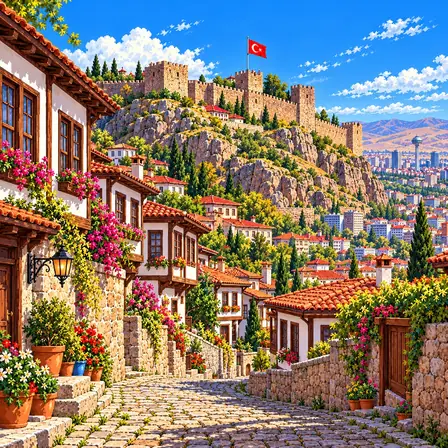
Ankara is the capital of Türkiye. It sits on high ground in the middle of the country. It became the capital about 100 years ago.

Ankara is the capital of Türkiye, where about 5.86 million people live (2024). It was a city that existed from ancient Hittite, Galatian, and Roman times, but in 1923 Mustafa Kemal Atatürk chose this city in the heart of Anatolia as the capital and developed it into the center of a modern nation. Istanbul is more famous, but Ankara is the real center of government, diplomacy, and defense.

Ephesus
Heritage

Ephesus

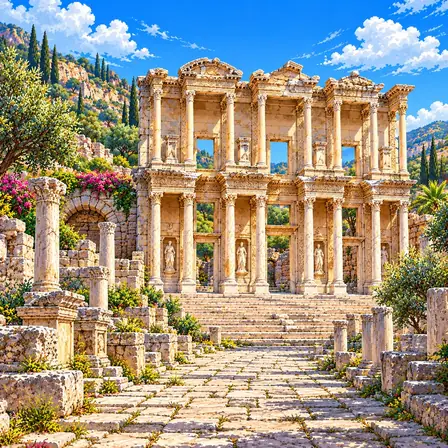
Ephesus is the ruins of a very old city. Long ago, about 200,000 people lived there. A great library and a round theater still stand.

Ephesus is the ruins of an ancient Greek and Roman city near Izmir in western Türkiye. From the 10th century BCE to the 7th century CE it was one of the largest cities in the Mediterranean, with about 200,000 people at its height. The Library of Celsus was one of the three great libraries of the ancient world, and its amphitheater held 25,000 people. The Apostle Paul preached in this city, and it became a UNESCO World Cultural Heritage site in 2015.

Cappadocia
Nature

Cappadocia

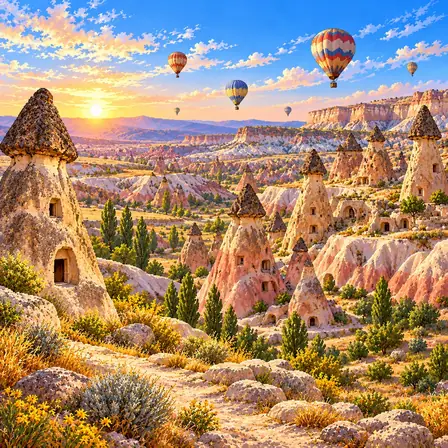
Cappadocia is full of rocks shaped like mushrooms. Rain and wind carved them from hardened volcanic ash. At dawn, hot-air balloons fill the sky.

Cappadocia is a landform where layers of tuff, piled up by volcanic eruptions, were worn down over millions of years by erosion into mushroom-shaped rocks and valleys. Underground cities and cave churches dug into the soft rock remain all over the area, and long ago people hid in the underground cities to escape wars. The dawn scenery of hot-air balloons is famous around the world, and it is a UNESCO World Cultural Heritage site.

Tulip
Plants

Tulip

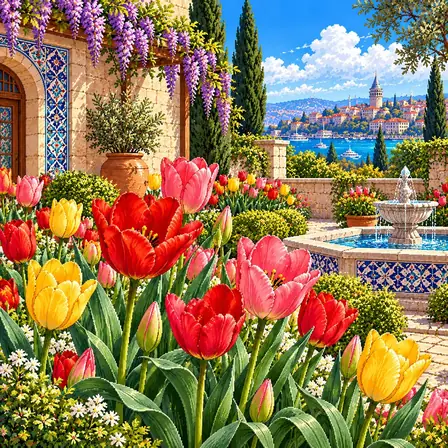
The tulip is a cup-shaped spring flower. Long ago, people in Türkiye thought it was the most precious flower. From there it spread to Europe and beyond.

The tulip is a flower that has long been loved in Türkiye's gardens and its art culture. In the days of the Ottoman Empire the tulip was honored as the finest of flowers, and that time is called the "Tulip Era" (Lale Devri). Millions of tulips bloom at the spring festival in Istanbul. The tulip even became a symbol of the Netherlands thanks to being carried from the Ottoman Empire to Europe.

Fez & Traditional Dress
Culture

Fez & Traditional Dress

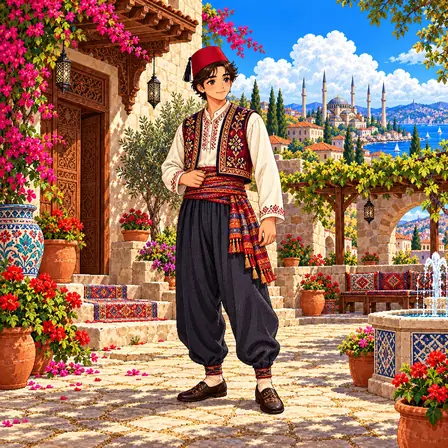
The fez is a red, cylinder-shaped hat with a black tassel on top. It was worn with a long, loose robe called a kaftan. Today you can see it at traditional shows and festivals.

The fez is a cylinder-shaped hat made of red felt, with a black tassel on top. It was widely worn in the 19th century, in the days of the Ottoman Empire, and became a hat that stood for this region. The kaftan worn with it is a long, loose outer robe, decorated richly with gold-thread embroidery on silk. A sash and jewel ornaments were added for a formal look. Today they show the old face of Türkiye at traditional performances and festivals.

Kebab
Food

Kebab

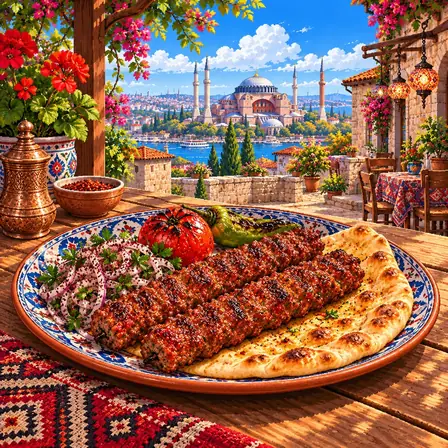
Kebab is meat cooked over a fire. One kind is roasted while it slowly turns around and around. The thin slices are eaten with bread or rice.

Kebab is Türkiye's best-known dish, made by grilling meat over fire. There are many kinds, such as döner kebab, where seasoned meat is stacked in layers and grilled while turning round and round, and şiş kebab, grilled on a skewer. Döner means "turning," and as the outside cooks, it is shaved off thinly with a long knife. The thinly shaved meat is eaten with rice, flat bread, or grilled vegetables. Because the meat and seasoning differ by region, many kebabs are named after cities.

Angora Cat
Animals

Angora Cat

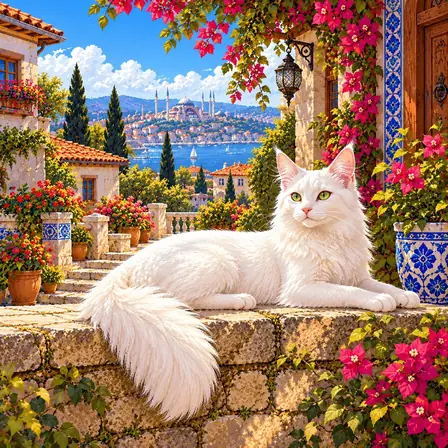
The Angora cat has long, soft white fur. Some have eyes of two different colors. In Türkiye it is treasured like a national treasure.

The Angora cat is a cat breed that came from the Ankara region, the capital of Türkiye. It is known for its long, silky-soft white fur and slim body. Sometimes an odd-eyed cat is born, with one blue eye and one amber eye. It is an old breed, with records going back hundreds of years, and in Türkiye it is treasured like a national treasure. The Ankara Zoo runs a conservation program to keep the pure bloodline.

Merhaba
Greeting

Merhaba

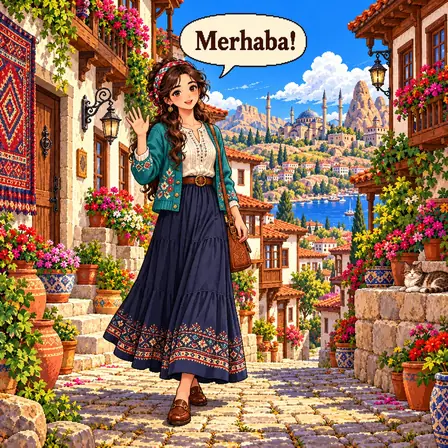
Merhaba means "hello" in Turkish. You can use it at any time of day. Turkish adds endings to words in a way similar to Korean.

"Merhaba" is read "mer-ha-ba," a Turkish greeting. It comes from an Arabic word meaning "welcome" and can be used any time of day. Turkish is a member of the Turkic language family from Central Asia, spoken by about 80 million people. Its structure, with endings added one after another to a word, is like Korean, so it is fairly easy for Koreans to learn. It has a history of switching to the alphabet instead of the Arabic script in 1928.

Türkiye's Flag
Flag

Türkiye's Flag

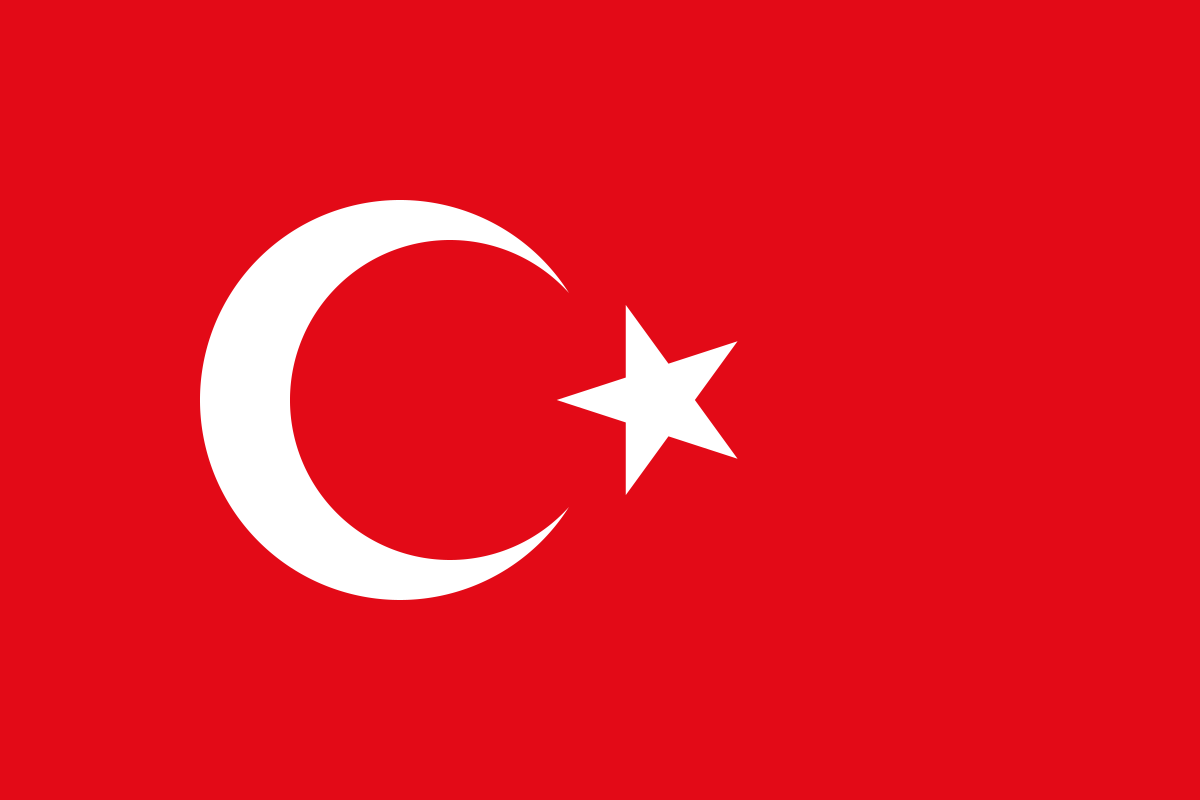
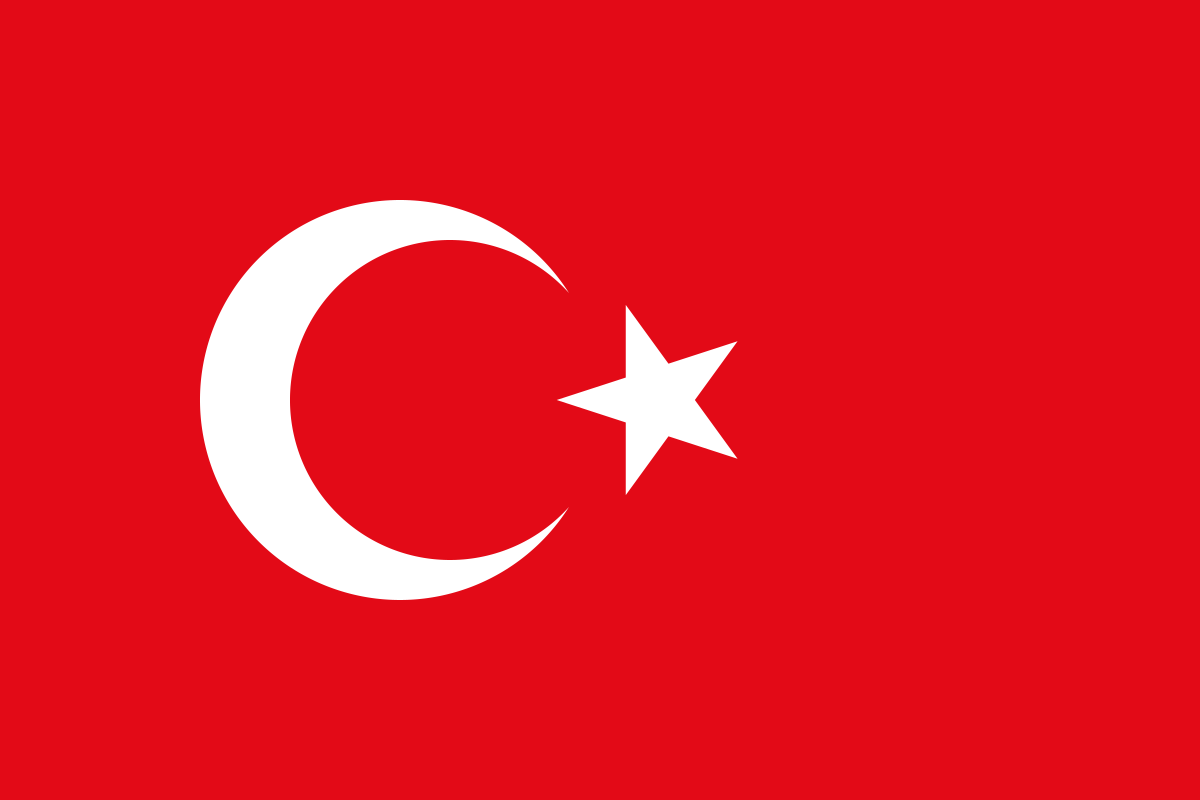
Türkiye's flag has a white crescent moon and star on a red background. The star sits neatly in the open side of the crescent. Its name means "moon and star."

Türkiye's flag has a white crescent moon and a single star on a red field. It is called the Ay Yıldız, which means "moon and star." The crescent and star are symbols widely used in the Islamic cultural world and have been on the flag since the days of the Ottoman Empire. The basic design was set in 1844, and even the proportions were fixed by law in 1936. Its trademark is the balanced layout, with the star tucked neatly into the open space of the crescent.

Sources