World Geography Atlas › Europe › Northern Europe

Norway

Norge

Fjords and the northern lights · the home of the Vikings.

Capital OsloPopulation About 5.5 millionArea 385,207 km²Language Norwegian
Map

Reading the land

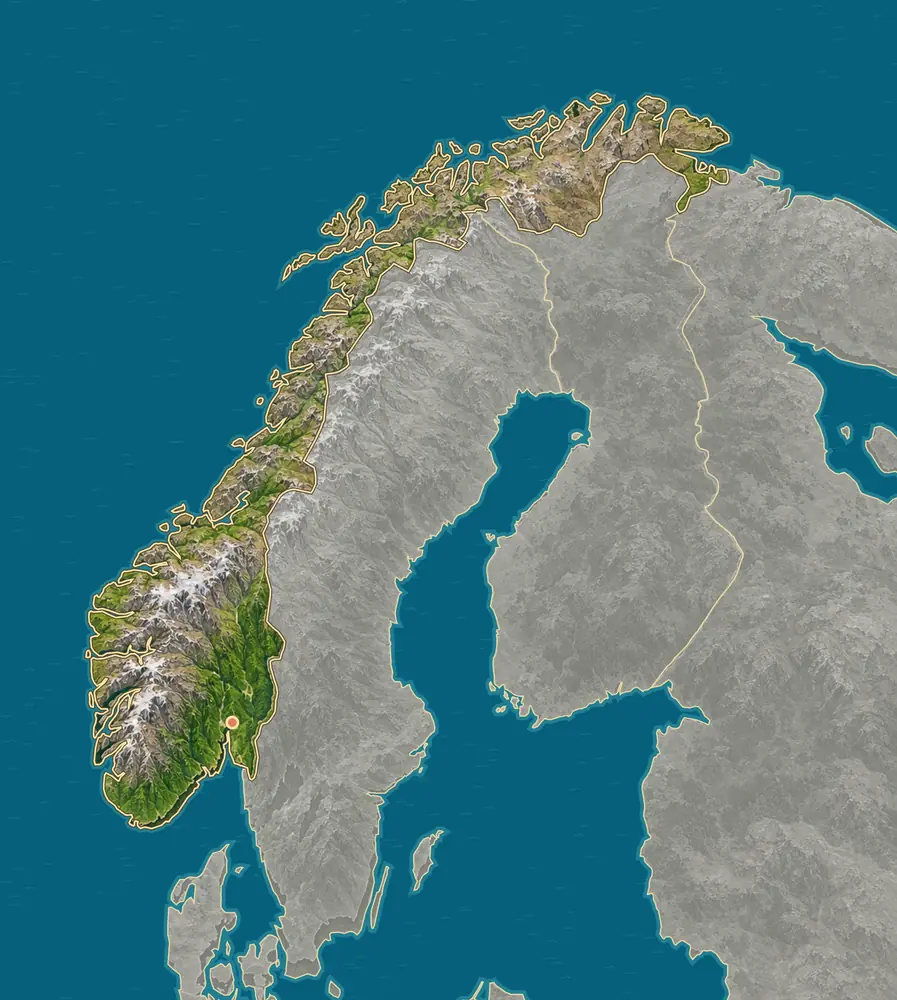
Illustrated map of Norway
Illustrated map: yenalab. Country outlines: Natural Earth (public domain).

Norway is full of mountains, and its coastline twists and turns. Glaciers carved deep valleys, and the sea flowed in to make fjords.

Mainland Norway is dominated by the Scandinavian mountains, with glacier-made fjords and islands along its west coast. Its highest peak is Galdhøpiggen (2,469 m). Svalbard and Jan Mayen lie in the northern seas.

Terrain

Coasts & islands

Fjords: the sea reaching inland

A fjord is a long, narrow inlet where the sea has filled a glacier-carved valley. Fjords such as Geirangerfjord and Nærøyfjord have towering cliffs and waterfalls. Countless small islands line the west coast.

Source: UNESCO, West Norwegian Fjords - Geirangerfjord and Nærøyfjord

Geology

Old rock and ancient mountains

Very old bedrock and rocks folded and altered during an ancient mountain-building event are exposed across Norway. Long erosion since then shaped today’s rocky landscape.

Source: Geological Survey of Norway, Geological mapping
Ice and fire

Svalbard combines mountains and glaciers, while Jan Mayen is crowned by the Beerenberg volcano. The ice-carved mainland and the distant volcanic island formed in very different ways.

Source: Norwegian Polar Institute, Jan Mayen

Collection

Norway Collection

A city, a heritage site, nature, a plant, culture, food, an animal, a greeting and the flag of Norway, each drawn as pixel art.

Oslo
City

Oslo

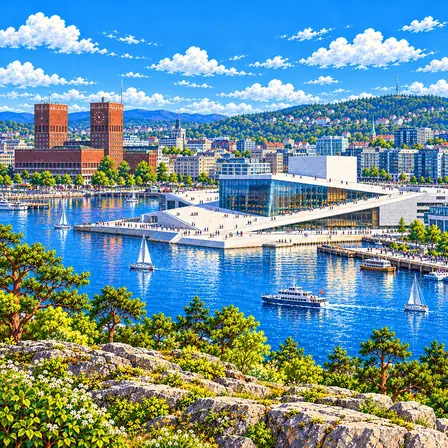
Oslo is the capital of Norway. It is a harbor city where the sea reaches deep into the land. Every year the Nobel Peace Prize ceremony is held there.

Oslo is Norway’s capital, at the inner end of Oslofjord. The Opera House, with its low white sloping roof, and City Hall, with its twin red-brick towers, are well-known landmarks. Forested hills lie close behind the harbor and modern buildings. The city preserves medieval traces alongside areas rebuilt after fire, and the name Oslo was restored in 1925. The Nobel Peace Prize ceremony takes place at Oslo City Hall.

Viking Ships
Heritage

Viking Ships

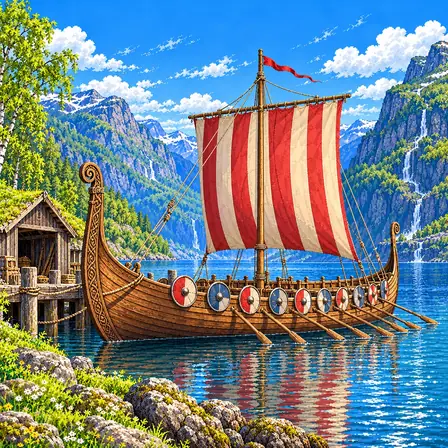
A Viking ship is a wooden boat the Vikings sailed more than 1,000 years ago. Its wooden planks were overlapped to make it strong. With sails and oars, it could travel far out to sea.

Viking-age vessels used clinker construction, with wooden planks overlapping along the hull. Shallow hulls, sails and oars supported travel along coasts and across open water; vessel designs varied with their purposes. The Oseberg and Gokstad ships found in Norway are notable ninth-century examples, with burial contexts that reveal aspects of contemporary life.

Geirangerfjord
Nature

Geirangerfjord

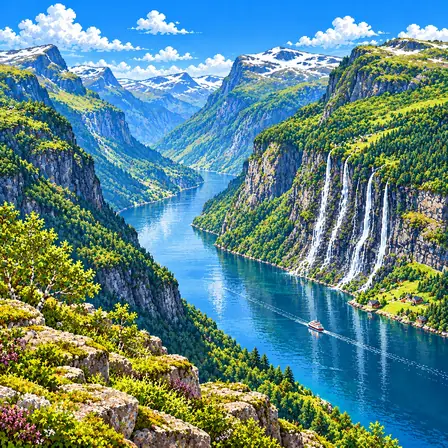
Geirangerfjord is a deep sea valley carved by glaciers. Seawater fills the space between high cliffs. Waterfalls pour down the cliffs in many streams.

Geirangerfjord is a deep inlet in western Norway. Glaciers widened and deepened its valley through repeated ice ages, and seawater entered after the ice retreated. Steep slopes, rocky cliffs, waterfalls and small cultivated patches sit close together. The group of slender falls is known as the Seven Sisters. The West Norwegian Fjords property, comprising Geirangerfjord and Nærøyfjord, was inscribed on the UNESCO World Heritage List in 2005.

Bergfrue
Plants

Bergfrue

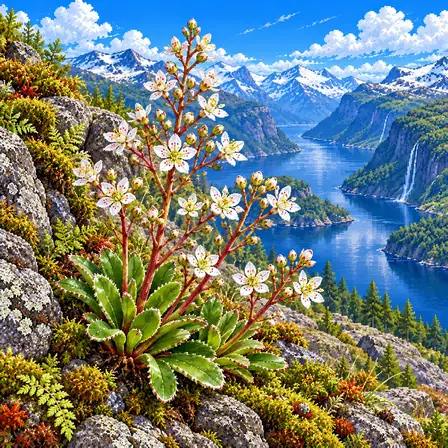
Bergfrue is a flower that grows in cracks in the rock. Its thick leaves gather in a circle at the bottom. Many small white flowers bloom on its thin stems.

Bergfrue, Saxifraga cotyledon, is a saxifrage rooted in rock crevices. Fleshy elongated leaves form basal rosettes, while branching flower stems carry many small white blooms. Flowers usually have five petals, with fine reddish markings near their bases. Its rosettes and branched flowering structure are more characteristic than a single large bloom.

Bunad
Culture

Bunad

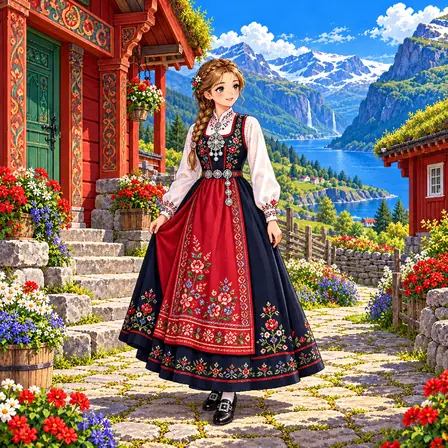
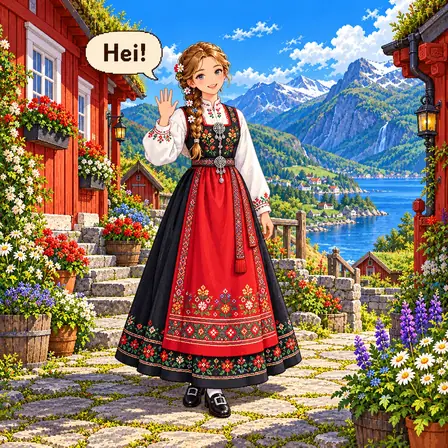
The bunad is Norway's traditional festive costume. Its colors and embroidery differ from region to region. Many people wear it on Constitution Day, May 17.

Bunad is Norwegian festive clothing developed from regional dress traditions. Fabric, color, embroidery and jewelry combinations vary between outfits and areas. A white blouse, dark bodice and skirt, a patterned apron and a silver brooch called a sølje are typical. Bunads are worn on occasions such as Constitution Day on May 17 and weddings, while making and repairing skills may be passed through families and communities. Norwegian traditional costume craftsmanship and social practice were inscribed on UNESCO’s Representative List in 2024.

Salmon Dishes
Food

Salmon Dishes

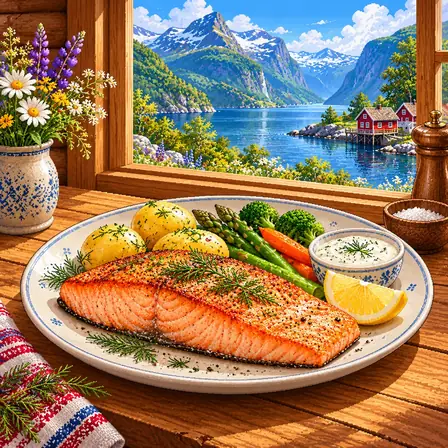
Salmon is a pink fish from the sea around Norway. People grill it or smoke it. Norway farms more salmon than any other country.

Salmon is important to Norway’s sea-based food traditions. It may be grilled, smoked or cured with salt, sugar and dill as gravlaks. Grilled salmon may be served with potatoes, vegetables, lemon and sauce. Norway farms more salmon than any other country.

Arctic Fox
Animals

Arctic Fox

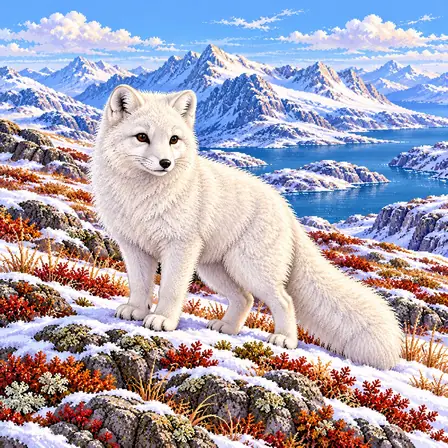
The Arctic fox is a small fox that lives in cold lands. Its small ears and thick fur help it handle the cold. In winter its fur turns as white as snow.

Arctic foxes inhabit Arctic tundra and alpine areas such as those of mainland Norway. Small ears and dense fur help limit heat loss. Many turn white in winter and darker in summer. A darker “blue” form stays dark even in winter. They use varied foods, including small mammals, birds, eggs and carrion, and their lives differ with season and habitat.

Hei
Greeting

Hei

Hei means "hi" in Norwegian. It is a friendly, everyday greeting. When leaving, people say "Ha det."

Hei, pronounced roughly “hey,” is a friendly everyday Norwegian greeting. Norwegian belongs to the North Germanic language group and has two official written standards, Bokmål and Nynorsk. Spoken dialects also vary by region. When leaving, people say “Ha det.”

Norway's Flag
Flag

Norway's Flag

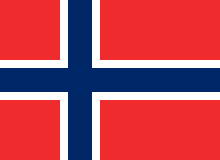
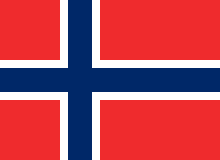
Norway's flag has a blue cross on a red background. A white border runs around the cross. It is a Nordic cross, set closer to the flagpole.

Norway's flag has a blue cross outlined in white on a red field. This shape, with the upright bar of the cross set toward the flagpole, is the "Nordic cross," a traditional design that the Nordic countries share. Its design was set in 1821. The three colors - red, white, and blue - are said to be taken from the flags of countries seen at the time as symbols of freedom. Because it resembles the flags of Denmark and Sweden, it is fun to line up the Nordic flags and compare them.

Sources