World Geography Atlas › North America › Caribbean

Jamaica

Jamaica

The island where reggae was born · a stair-step waterfall that pours into the sea.

Capital KingstonPopulation About 2.8 millionArea 10,991 km²Language English
Map

Reading the land

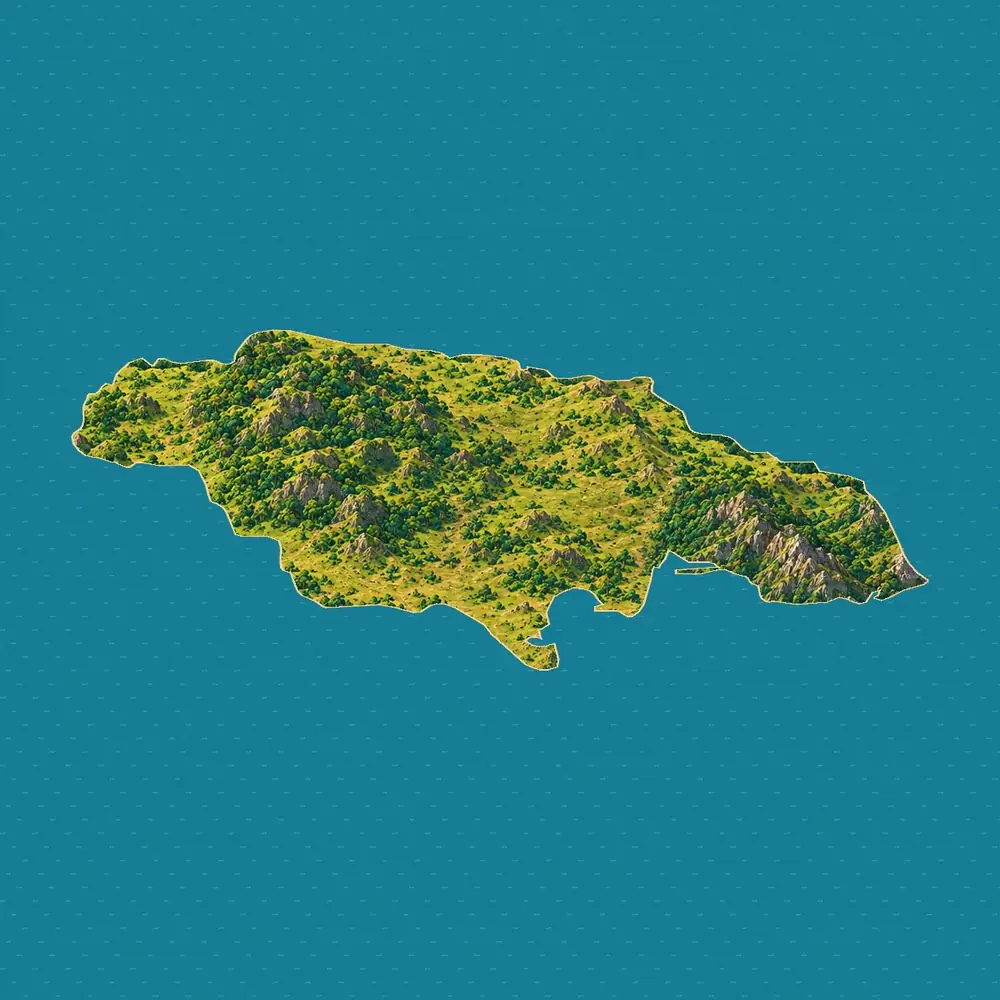
Illustrated map of Jamaica
Illustrated map: yenalab. Country outlines: Natural Earth (public domain).

Jamaica is a green island full of mountains and forest. The Blue Mountains, the highest on the island, rise in the east. In the west lies limestone hill country where round hills and hollows follow one after another.

Jamaica has mountains and hills running along its middle, with plains along the coast. The Blue and John Crow Mountains rise in the east, the bumpy limestone land of Cockpit Country lies in the west, and a long sand spit wraps around Kingston Harbour in the south.

Terrain

Cockpit Country, land of hills and hollows

Cockpit Country in the west of the island is an endless pattern of cone-shaped hills and bowl-shaped hollows. It covers about 1,300 km², roughly 12% of Jamaica.

Source: IUGS, The White Limestone Karst of Cockpit Country

Sea & water

Kingston Harbour behind a sand spit

A long, narrow sand spit called the Palisadoes reaches out in front of the capital, Kingston, sheltering its wide harbour from the open sea. The spit, its mangrove forests and the surrounding waters are protected as a Ramsar wetland of about 75 km².

Source: Ramsar Convention, Palisadoes - Port Royal (Ramsar Site 1454)

Water that flows underground

Plenty of rain falls on Cockpit Country every year, but it quickly soaks into cracks in the limestone, so there are almost no rivers on the surface. The water flows through underground caves and channels and comes back up as springs.

Source: IUGS, The White Limestone Karst of Cockpit Country

Geology

Cockpits carved from limestone

The white limestone of Cockpit Country formed long ago on a warm sea floor. Rainwater dissolved the cracks in the rock until the hollows grew larger, leaving cone-shaped hills between them. Around the world this kind of landscape is called cockpit karst, after this place.

Source: IUGS, The White Limestone Karst of Cockpit Country

A spit that joined an island

The Palisadoes formed as waves carried sand and gravel along the coast and piled them into a long strip. Once the spit linked up with the land at Port Royal at its tip, its seaward edge became a natural breakwater around Kingston Harbour.

Source: Ramsar Convention, Palisadoes - Port Royal (Ramsar Site 1454)

Collection

Jamaica Collection

A city, a heritage site, nature, a plant, culture, food, an animal, a greeting and the flag of Jamaica, each drawn as pixel art.

Kingston
City

Kingston

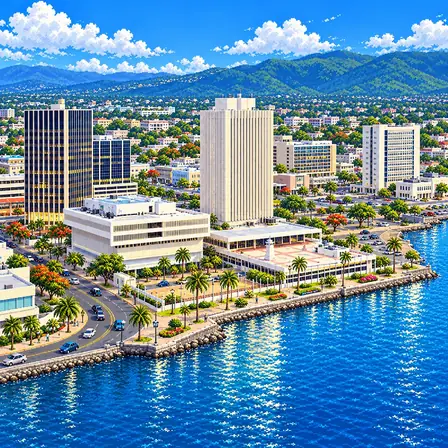
Kingston is the capital of Jamaica. Tall buildings line its wide harbor. Blue mountains rise behind the city.

Kingston is the capital of Jamaica, on the southeast coast of the island. In 1692 a great earthquake destroyed most of Port Royal, the harbor town across the water, and survivors moved over and founded a new town. Its wide harbor, sheltered from the sea by a long sandbar called the Palisadoes, is known as the seventh-largest natural harbor in the world. Tall buildings such as the Bank of Jamaica headquarters line the downtown waterfront along the harbor, and the Blue Mountains rise behind them. It became the capital in 1872 and is now Jamaica's largest city.

Devon House
Heritage

Devon House

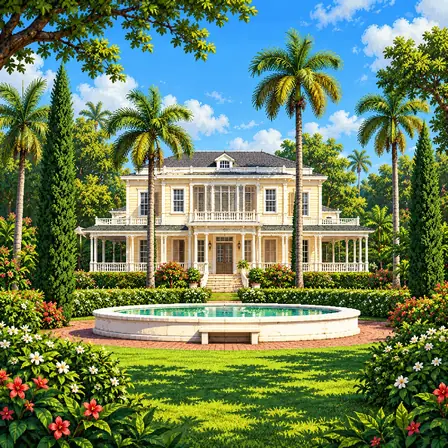
Devon House is a white mansion built around 1881. It has shutters that let the breeze through and a wide veranda. Today it is a museum anyone can visit.

Devon House is a white two-story mansion in Kingston, built around 1881 by the businessman George Stiebel. Stiebel is known as Jamaica's first Black millionaire. Its English Georgian style, with both sides neatly matching, was adapted to the hot climate with louvered shutters called jalousies that let breezes through and a wide veranda wrapped around the house. The Jamaica National Heritage Trust declared it a national monument in 1990, and it was restored and furnished with period furniture as a museum. With its wide gardens, shops and an ice cream shop, it is a favorite place for local people.

Dunn's River Falls
Nature

Dunn's River Falls

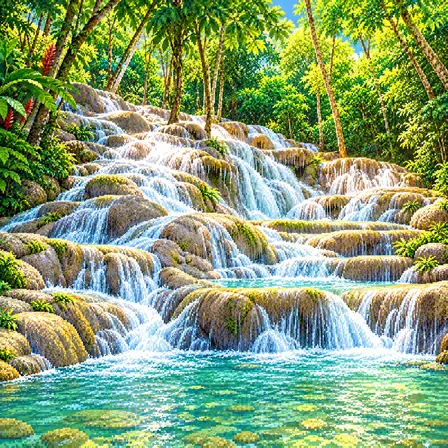
Dunn's River Falls is a waterfall that tumbles down like stairs to the beach. Lime in the water built up into step-shaped rocks. People hold hands and climb up the falls.

Dunn's River Falls is a waterfall near Ocho Rios on Jamaica's north coast that pours straight into the sea. Spring water that has flowed through limestone carries a lot of dissolved lime, which builds up bit by bit on the rocks to form step-like ledges called travertine terraces. So instead of dropping all at once, the water tumbles down many low steps, with a total height of about 55 m and a length of about 180 m. Travertine waterfalls that pour straight into the sea are rare in the world. It is famous as a place where people hold hands and climb up the falls step by step.

Ackee
Plants

Ackee

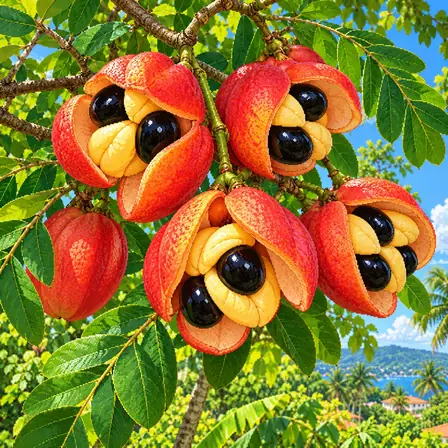
The ackee is a tree whose red fruit splits open by itself. Inside are black seeds and yellow flesh. It is eaten only after it is fully ripe and open.

The ackee is an evergreen fruit tree of the soapberry family that is common in Jamaica. It first grew in West Africa and was brought to Jamaica in the 18th century. When its fruit ripens red, it splits open on its own, and inside, each shiny black seed sits on a creamy yellow flesh called an aril. Unripe fruit contains a harmful substance called hypoglycin, so the fruit must be picked only after it has opened by itself, and only the yellow flesh is cooked and eaten. Jamaicans love ackee fried with salted fish for breakfast.

Reggae Music
Culture

Reggae Music

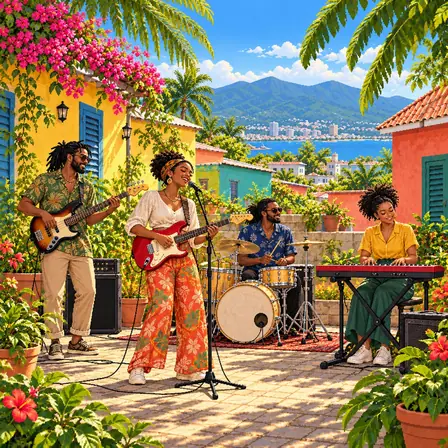
Reggae is music that began in Jamaica. The guitar goes "chk, chk" in short beats over a relaxed rhythm. It is part of UNESCO's Intangible Cultural Heritage.

Reggae is music that arose in Kingston, Jamaica, in the late 1960s. Fast ska turned into slower rocksteady, and with American soul and rhythm and blues added, it became reggae. Guitar and keyboard play short, choppy chords on the second and fourth beats, while heavy bass and drums lead a relaxed rhythm. Its songs tell of love, faith and everyday life, carrying the voices of many people. In 2018, "Reggae music of Jamaica" was inscribed on UNESCO's list of the Intangible Cultural Heritage of Humanity.

Jerk Chicken
Food

Jerk Chicken

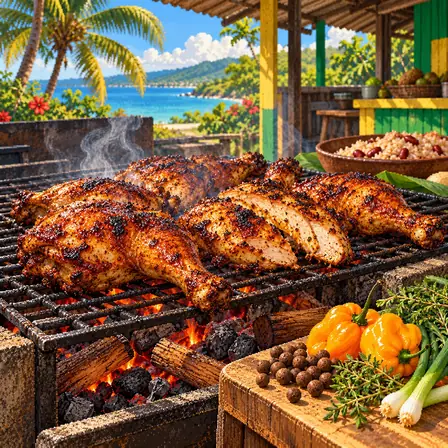
Jerk chicken is chicken soaked in a spicy marinade and grilled over wood smoke. The seasoning has sweet-smelling pimento and hot peppers. It is grilled and sold at roadside stands.

Jerk chicken is a Jamaican dish of chicken soaked in a spicy marinade and slowly grilled over charcoal and wood smoke. The seasoning includes allspice berries, called pimento, very hot Scotch bonnet peppers, thyme, scallions, garlic and ginger. It continues the way the Maroons, who long lived in villages in the mountains, seasoned meat and cooked it slowly over pimento-wood fires. Boston Bay on Jamaica's east coast is especially famous for jerk cooking. It is grilled at roadside stands and eaten with bread or with rice cooked with beans.

Homerus Swallowtail
Animals

Homerus Swallowtail

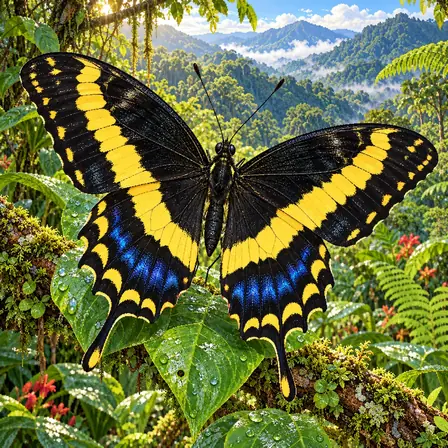
The Homerus swallowtail is the largest butterfly in the Americas. Its dark wings have wide yellow bands. It lives only in the mountain forests of Jamaica.

The Homerus swallowtail lives only in Jamaica and is the largest butterfly in the Americas. Wide yellow bands cross its dark wings, and its hind wings have blue spots and tail-like points. It lives in rainy mountain forests, and its caterpillars eat the leaves of only a few kinds of trees that grow in those forests. It was once found in 7 of Jamaica's 14 parishes, but now it remains in only two places: Cockpit Country in the west and the Blue and John Crow Mountains in the east. Because its forests have shrunk and people have collected it, it is protected as an endangered species.

Wah gwaan!
Greeting

Wah gwaan!

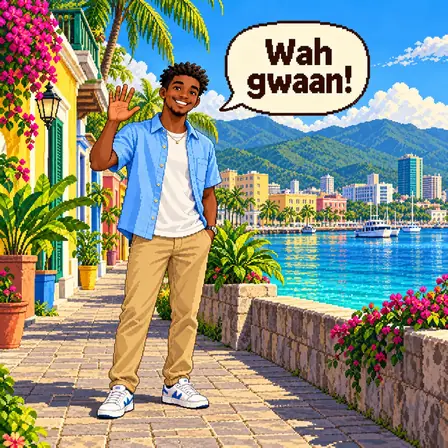
Wah gwaan means "What's up?" or "How are you doing?" in Jamaica. It comes from English "What's going on?" Friends greet each other this way.

Wah gwaan, read "wah gwahn," is a greeting in Jamaican Creole, or Patois, meaning "What's up?" or "How are you doing?" It is English "What's going on?" changed into the Jamaican way of speaking. A creole is a new language that grows from several languages meeting and becomes a community's first language, and Patois grew from English mixed with African languages, Spanish and more. Jamaica's official language is English, used in schools and official papers, while Patois is often heard in conversations between friends and in songs. In Jamaica, home to about 2.8 million people, the two are used side by side.

Jamaica's Flag
Flag

Jamaica's Flag

Jamaica's flag is split into four parts by a gold X. The top and bottom are green, and the sides are black. It was first raised on the day of independence in 1962.

Jamaica's flag is divided into four sections by a gold X-shaped cross, with green sections at the top and bottom and black sections on the left and right. It was first raised on August 6, 1962, the day Jamaica became independent. The Jamaican government explains that black stands for the strength and creativity of the people, gold for the country's natural wealth and the beauty of the sunlight, and green for hope and farming resources. It is also well known as a national flag that uses no red, white or blue at all. Its width is twice its height.