World Geography Atlas › Asia › Southeast Asia

Indonesia

Indonesia

One of the countries with the most islands in the world · Bali.

Capital JakartaPopulation About 280 millionArea 1,904,569 km²Language Indonesian
Map

Reading the land

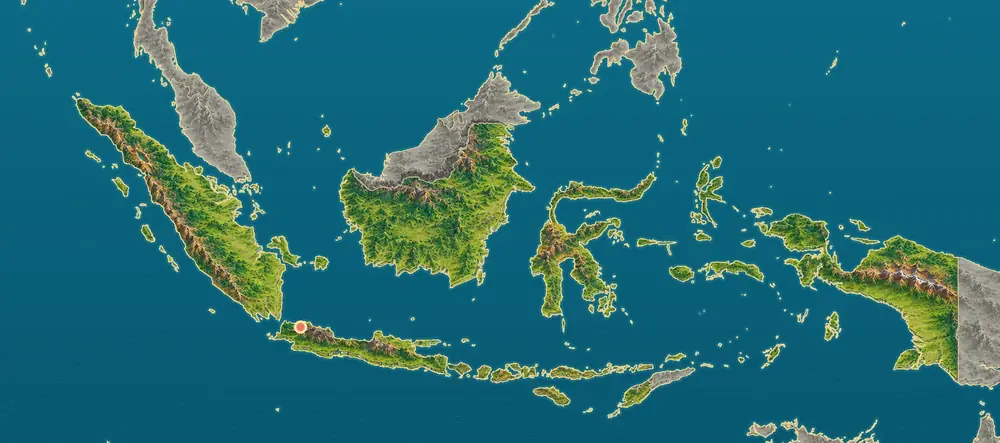
Illustrated map of Indonesia
Illustrated map: yenalab. Country outlines: Natural Earth (public domain).

Indonesia is a country of many islands strung along the equator. The islands have lots of volcanoes, and the hot, rainy weather keeps the forests thick and green.

Indonesia spreads between the Indian and Pacific Oceans. Large islands such as Sumatra, Java, Kalimantan, Sulawesi and western New Guinea, along with many smaller ones, form volcanic ranges along plate boundaries.

Terrain

Each island is different

Kalimantan has forested mountains and low plains crossed by large rivers. Sulawesi is a mountainous island with several long arms, and western New Guinea has high central ranges.

Source: NASA Earth Observatory, Kalimantan, Borneo, Indonesia

Coasts & islands

Geology

Collection

Indonesia Collection

A city, a heritage site, nature, a plant, culture, food, an animal, a greeting and the flag of Indonesia, each drawn as pixel art.

Jakarta
City

Jakarta

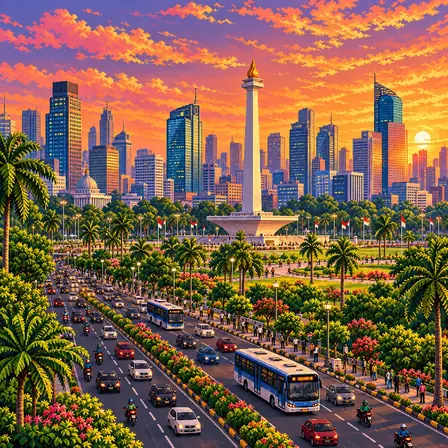
Jakarta is the biggest city in Indonesia. The Monas tower has a golden flame on its top. The tower celebrates the country's independence.

Jakarta is a large city on the northwest coast of Java and plays a major role in Indonesia’s administration and economy. The Monas monument in Merdeka Square has a golden flame at its top and commemorates independence. Modern towers, roads and tropical trees shape the city, while Kota Tua preserves buildings from the Batavia period, when the Dutch ruled the city. Indonesia is developing Nusantara in Kalimantan to relocate government functions.

Borobudur
Heritage

Borobudur

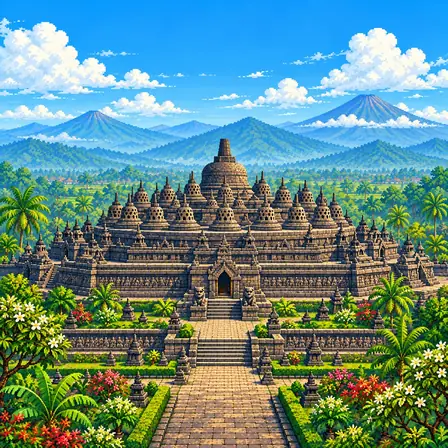
Borobudur is a huge Buddhist temple more than 1,000 years old. You climb its stone levels by stairs. At the top, bell-shaped stone stupas stand in rows.

Borobudur is a Buddhist monument in the Kedu Valley of central Java, built in the eighth and ninth centuries. Broad square terraces support circular platforms and a large central stupa. Rows of perforated bell-shaped stupas stand on the upper platforms, while finely carved reliefs decorate the lower walls. Stairways connect the levels. Major restoration in the twentieth century involved Indonesia and UNESCO, and the temple is preserved as a World Heritage site.

Mount Bromo
Nature

Mount Bromo

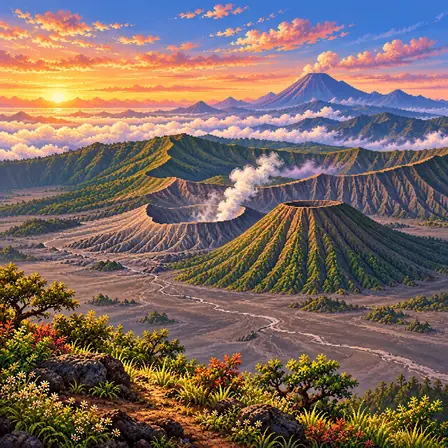
Bromo is a volcano that still puffs out smoke. Around it lies a wide, sandy plain covered with volcanic ash. The view is especially beautiful at sunrise.

Bromo is an active volcano in the Tengger volcanic landscape of eastern Java. Ash and sand cover the broad caldera floor, and Bromo’s crater contrasts with neighboring Mount Batok. Eruptions and erosion shape the craters, fluted slopes and surrounding plain.

Rafflesia
Plants

Rafflesia

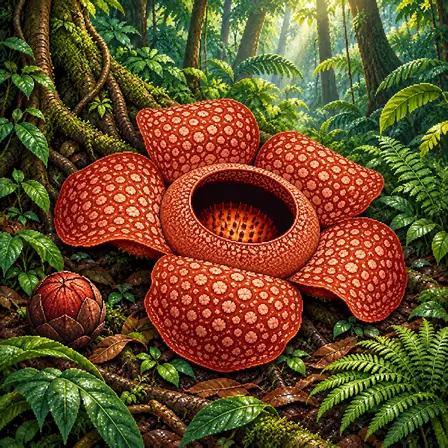
Rafflesia is the biggest flower in the world. When it opens, it can be 1 m across. It smells bad on purpose to bring flies that carry its pollen.

The rafflesia is an unusual flower you can see in the rainforests of Sumatra and Borneo in Indonesia. It is the largest single flower in the world, reaching up to 1 m across. With no leaves or stem, it lives by parasitism on a host plant and rarely blooms. It is a mysterious flower that draws flies with a strong smell to help with pollination.

Kebaya
Culture

Kebaya

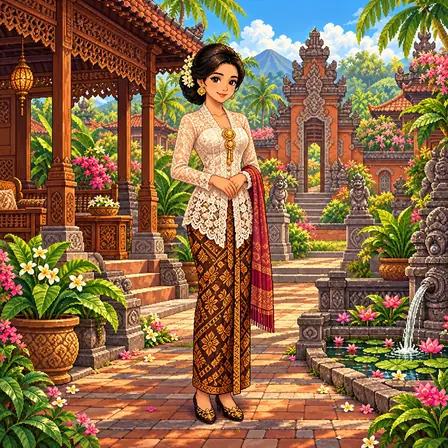
The kebaya is a traditional blouse that closes at the front. Its thin cloth has delicate flower embroidery. It is worn with a batik-patterned skirt.

The kebaya is a front-opening traditional blouse worn in Indonesia and other parts of Southeast Asia. Fine fabric may carry intricate embroidery or lace, with brooches or buttons used as fasteners. In Indonesia it is often paired with a batik kain or sarong. Colors and forms vary by region and occasion. In 2024, knowledge, skills and traditions related to the kebaya were inscribed by UNESCO through a joint nomination from Indonesia and four other countries.

Nasi Goreng
Food

Nasi Goreng

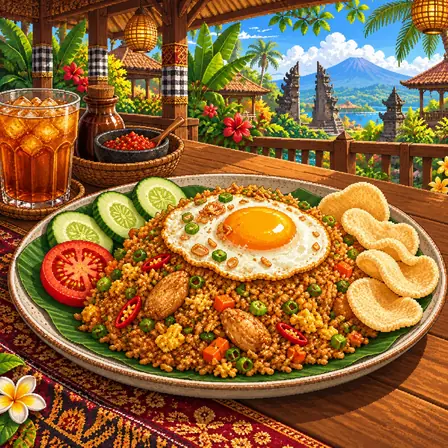
Nasi goreng means "fried rice." It is fried with sweet soy sauce, so it tastes sweet and salty. It is topped with a fried egg and served with crunchy shrimp crackers.

Nasi goreng, which means "fried rice," is Indonesia's best-known fried rice. It is stir-fried with a sweet soy sauce called kecap manis, giving it a deep color and a sweet-and-salty taste. Because it can easily be made with leftover rice, many people also eat it for breakfast. A fried egg is placed on top, and it is served with shrimp crackers called krupuk along with cucumber and tomato. In Indonesia, made up of more than 17,000 islands, the ingredients differ a little from region to region.
Komodo Dragon
Animals

Komodo Dragon

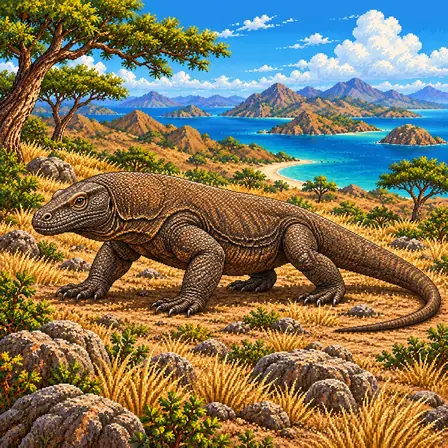
The Komodo dragon is the biggest lizard in the world. It can grow up to 3 m long, longer than a grown-up is tall. It flicks its long tongue to smell food far away.

The Komodo dragon is the largest lizard in the world, growing more than 3 m long and over 70 kg. It lives only on the dry grasslands of Komodo Island and a few islands around it in Indonesia. By flicking its long tongue, it reads smells in the air to find food even a few kilometers away. It hunts deer and wild boar, and scientists were surprised to learn that its saliva contains venom. Because it lives in such a small area, it is protected as an endangered species, and its habitat is set aside as Komodo National Park.

Selamat pagi
Greeting

Selamat pagi

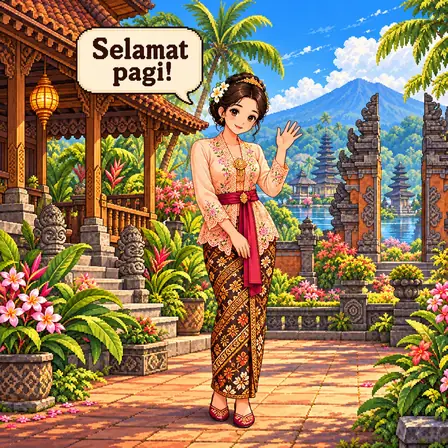
Selamat pagi means "good morning." Different greetings are used in the afternoon and at night. Indonesian is written with the same alphabet as English.

Selamat pagi means “Good morning” in Indonesian and is a polite greeting used in the morning. Other expressions suit other times, including Selamat siang around midday and Selamat malam at night. Indonesian is the official language connecting diverse island and language communities, and it is written in the Latin alphabet.

Indonesia's Flag
Flag

Indonesia's Flag

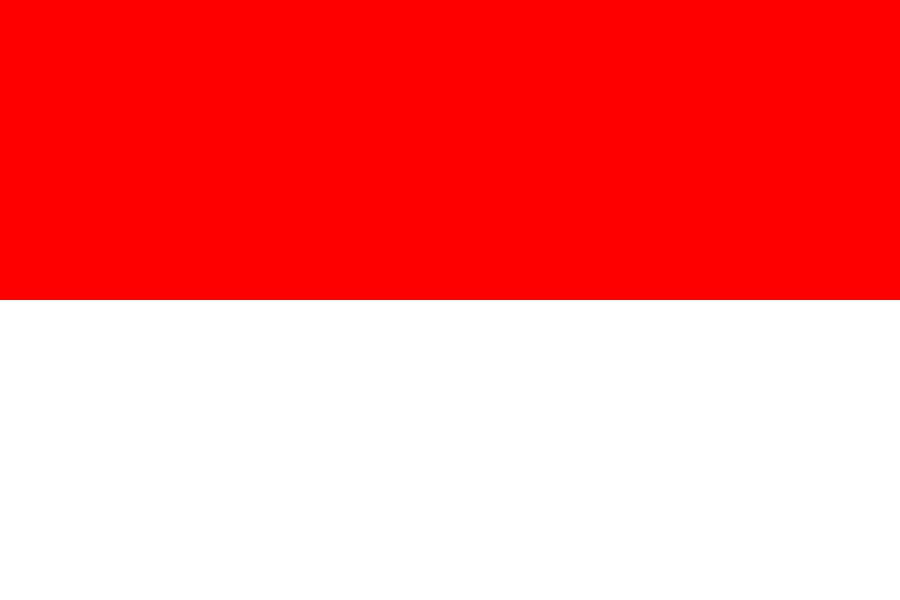
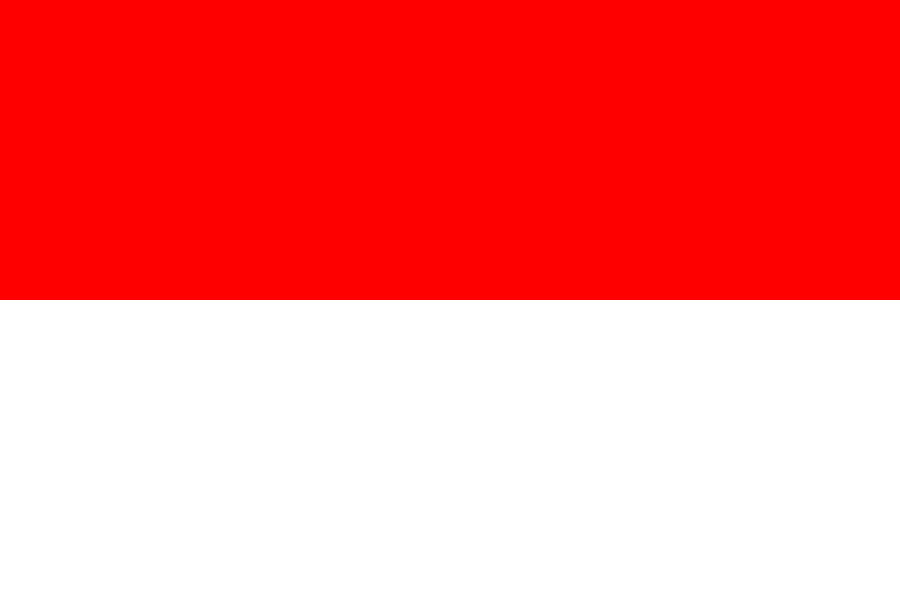
Indonesia's flag is red on top and white on the bottom. It is a very simple flag with just two colors. Red stands for courage and white for a pure heart.

Indonesia's flag is made of just two colors - red on top and white on the bottom. It is called "Sang Saka Merah Putih" (the red-and-white flag). Officially, red stands for courage and white for purity. It is said to carry on from the red-and-white flag used by the Majapahit kingdom about 700 years ago. It has the same colors as Monaco's flag, but you can tell them apart because their width-to-height ratios differ.

Sources