World Geography Atlas › Europe › Eastern Europe

Hungary

Magyarország

A Parliament on the Danube · the country of paprika and goulash.

Capital BudapestPopulation About 9.5 millionArea 93,028 km²Language Hungarian
Map

Reading the land

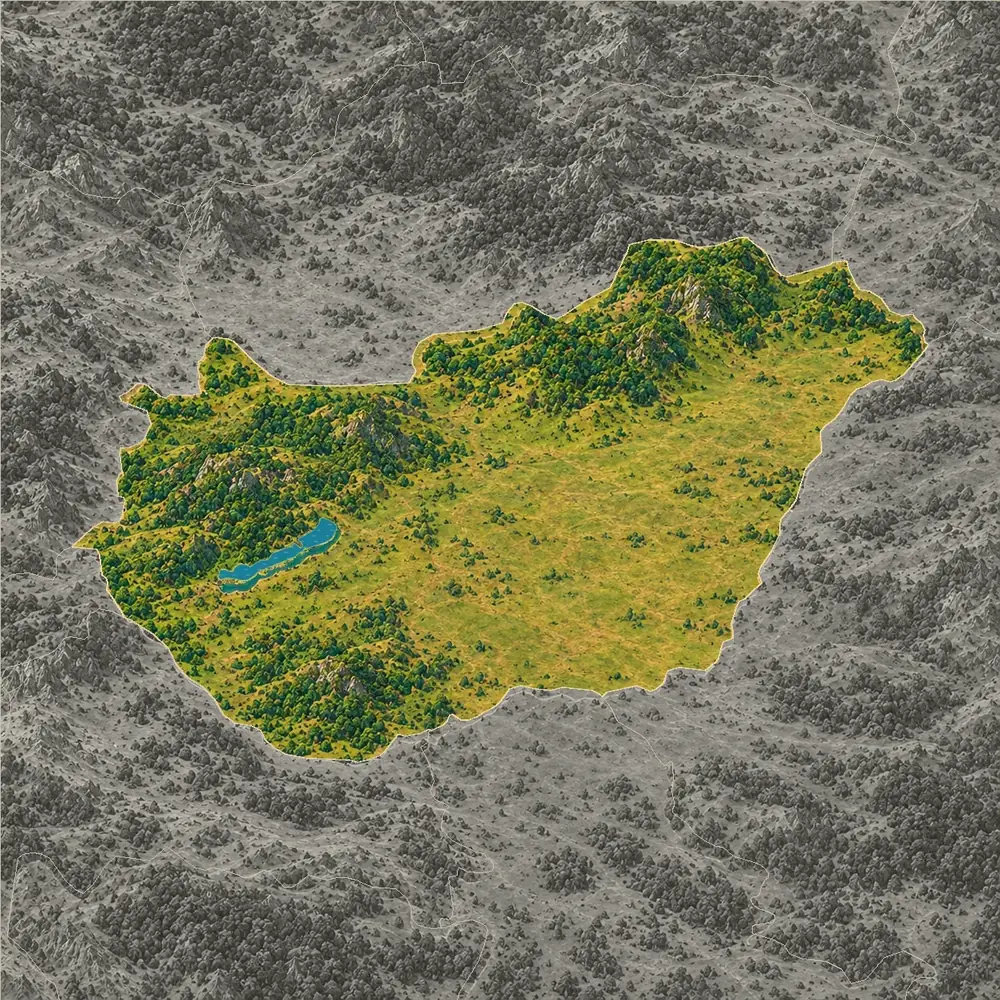
Illustrated map of Hungary
Illustrated map: yenalab. Country outlines: Natural Earth (public domain).

Hungary has no sea, and more than half of its land is low, flat plain. Low, forested mountains rise in the north and west. In the west lies Lake Balaton, the largest lake in Central Europe.

Hungary sits in the middle of a large basin ringed by high mountain ranges. The Great Hungarian Plain covers the south and east, the North Hungarian Mountains rise in the north, and the Transdanubian Mountains and Lake Balaton lie in the west.

Terrain

Rivers & lakes

Wide, shallow Lake Balaton

Lake Balaton in the west covers about 590 km², making it the largest lake in Central Europe. The Zala River feeds it at its western end, and its average depth is only about 3 m. The reed beds and marshes on its shores are protected as a Ramsar wetland where water birds rest.

Source: European Space Agency, Hungary · Ramsar Convention, Lake Balaton (Ramsar Site 421)

The Danube crosses the country

In landlocked Hungary, the Danube flows across the country from north to south. Water from Lake Balaton also leaves at its eastern end through the Sió canal and joins the Danube. Budapest, the capital on the river, has so many warm springs rising from underground that it is called the City of Spas.

Source: European Space Agency, Hungary

Geology

Collection

Hungary Collection

A city, a heritage site, nature, a plant, culture, food, an animal, a greeting and the flag of Hungary, each drawn as pixel art.

Budapest
City

Budapest

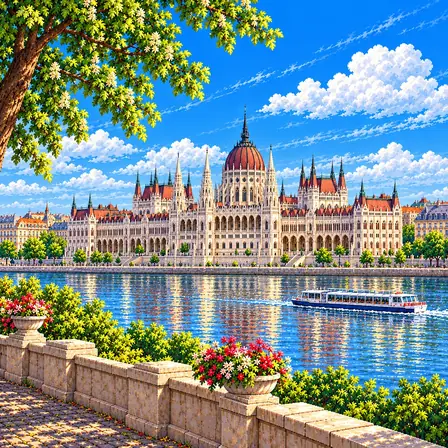
Budapest is the capital of Hungary. The city spreads along both sides of the Danube River. A huge Parliament Building with pointed towers and a round dome stands by the river.

Budapest is the capital of Hungary, where hilly Buda on the west bank faces flat Pest on the east bank across the Danube. As a river crossing and a busy waterway, it drew people and goods from early times, and in 1873 Buda, Pest and Óbuda joined to become one city. The Parliament Building on the Pest riverbank is a Gothic Revival building 268 m long, with a dome rising 96 m, finished in 1904. The banks of the Danube, lined with bridges and historic buildings, were inscribed on the UNESCO World Heritage List in 1987. Today about 1.7 million people live in Budapest, Hungary's largest city.

Old Village of Hollókő
Heritage

Old Village of Hollókő

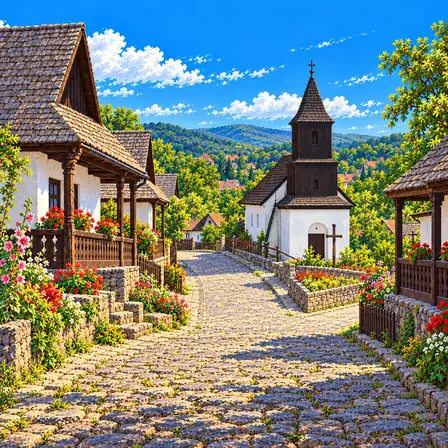
Hollókő is an old village in the hills of northern Hungary. Houses with white walls and wooden posts line its stone lanes. People still live in this World Heritage village today.

Hollókő is an old village of the Palóc people, set in a valley among low hills in northern Hungary. Its houses stand on stone foundations with timber frames and white-washed earthen walls, and wooden porches with posts and railings face the street. The village burned several times, and after the last great fire in 1909 it was rebuilt in the same traditional way. With the wooden bell tower of its small church and narrow stone lanes, it shows how country life looked long ago. It was inscribed on the UNESCO World Heritage List in 1987, and people still live there and keep up its traditional festivals.

Lake Balaton
Nature

Lake Balaton

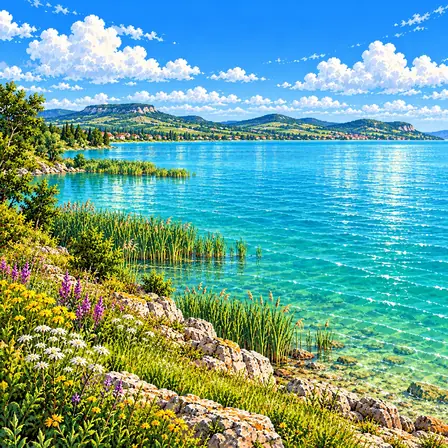
Lake Balaton is the largest lake in Central Europe. It is very wide but only about twice as deep as a grown-up is tall. So the water warms up quickly in summer.

Lake Balaton, stretched out long in western Hungary, is the largest lake in Central Europe. It formed when water filled a long, low hollow where the land had sunk. It is about 77 km long and covers about 590 km², but its average depth is only about 3 m, so the water warms quickly in summer and waves rise easily when the wind blows. Wide reed beds along the shore shelter water birds and fish, and on the north shore stand flat-topped hills left by ancient volcanoes. The lake and its wetlands are protected as a Ramsar site, and in summer many people come to swim and play in the water.

Spice Paprika
Plants

Spice Paprika

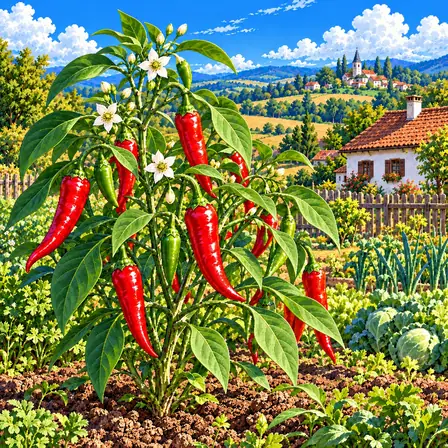
Spice paprika is a pepper plant with long red fruits. When the fruits are dried and ground, they turn into a red powder. It adds color and flavor to Hungarian food.

Spice paprika is a well-known pepper plant in Hungary, from the nightshade family. It first grew in the Americas, and after it reached Europe it came to be grown widely around Szeged and Kalocsa in sunny southern Hungary. Pointed, smooth-edged leaves grow on its branching stems, and after its small white flowers fall, long fruits form and ripen red. When the ripe fruits are dried and finely ground, they become a red powdered spice that gives dishes like goulash their color and flavor. In the 1930s, the Szeged scientist Albert Szent-Györgyi obtained plenty of vitamin C from paprika for his research, and in 1937 he received the Nobel Prize in Physiology or Medicine.

Matyó Embroidery
Culture

Matyó Embroidery

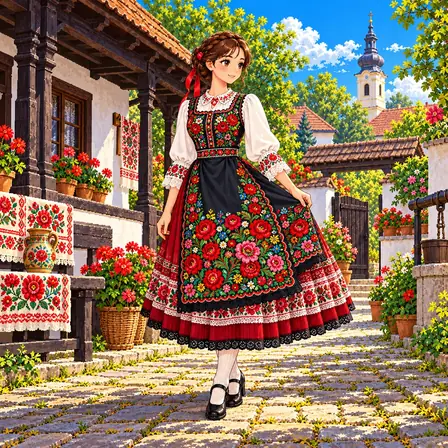
Matyó embroidery is flower needlework stitched on clothes and cloth in northeastern Hungary. Small flowers and leaves fill the space around a big red rose. People dress up in it for festivals.

Matyó embroidery is the flower-pattern needlework that the Matyó people of northeastern Hungary stitch onto clothing and cloth. In the 19th century it was first sewn mostly in red and blue thread, but bright colors such as pink, green and yellow were gradually added and it grew more colorful. Its central motif is a large flower called the Matyó rose, surrounded closely by small flowers and leaves. Skirts, aprons, blouse sleeves, tablecloths and pillowcases were all embroidered and worn or used for weddings and festivals. It was inscribed on UNESCO's list of the Intangible Cultural Heritage of Humanity in 2012, and today it is passed on to the next generation in workshops and schools.

Goulash
Food

Goulash

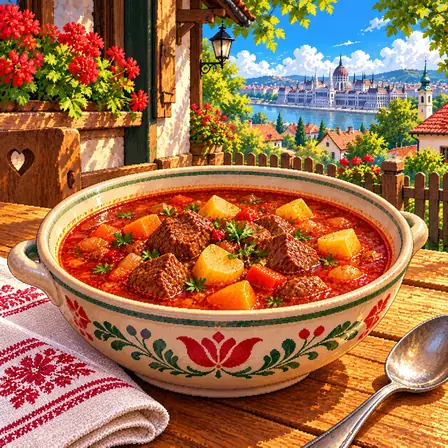
Goulash is a red soup cooked with beef and potatoes. Paprika powder gives it its red color. It began as food made by herdsmen who looked after cattle on the plains.

Goulash is a red Hungarian soup made by slowly simmering beef with onions and paprika powder. In Hungarian it is called gulyás, a word for the herdsmen who looked after cattle on the wide plains. Its name is said to come from the meat dishes the herdsmen cooked in kettles hung over fires out in the fields. Onions are fried in fat, then paprika powder and meat are added, followed by potatoes and carrots, and it is simmered with plenty of broth. It became widely known as a dish that represents Hungary in the 19th century, and people still eat it with a spoon like soup, with bread on the side.

Puli
Animals

Puli

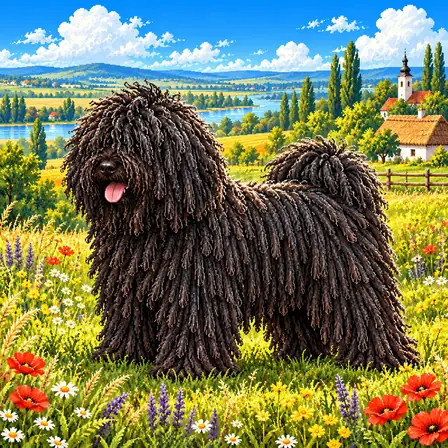
The Puli is a dog that looked after flocks of sheep in Hungary. The fur all over its body tangles into thick cords like ropes. This coat keeps out rain and cold.

The Puli is a medium-sized sheepdog that herded and guarded flocks of sheep in Hungary. Males stand about 39-45 cm at the shoulder and weigh about 13-15 kg, with a square, sturdy body and a tail curled up over the back. Its most striking feature is its coat: the soft undercoat and rough outer coat tangle together and form thick, rope-like cords on their own. This coat kept out rain and cold, letting the dog work for long hours on the open plains. Quick on its feet and a good jumper, it rounded up straying sheep swiftly, and today it is also loved as a family pet.

Szia!
Greeting

Szia!

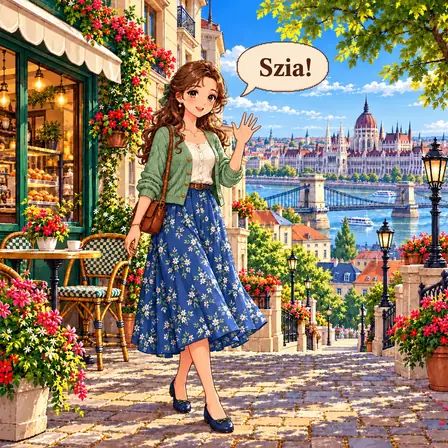
Szia means "hi" and "bye" in Hungarian. People say it both when they meet and when they part. To grown-ups they say "Jó napot."

Szia, read "see-aw," is a Hungarian greeting used among friends and family, both when meeting and when saying goodbye. To a group you say Sziasztok, and to grown-ups you greet politely with Jó napot. In Hungarian, sz makes an "s" sound, and a is said with rounded lips, so it sounds between "uh" and "oh." Hungarian belongs to the Uralic family, unrelated to its neighbors' languages, and shares distant roots with Finnish and Estonian. About 13 million people speak it; it adds meaning by attaching pieces to the ends of words one after another, and the first syllable is always stressed.

Hungary's Flag
Flag

Hungary's Flag

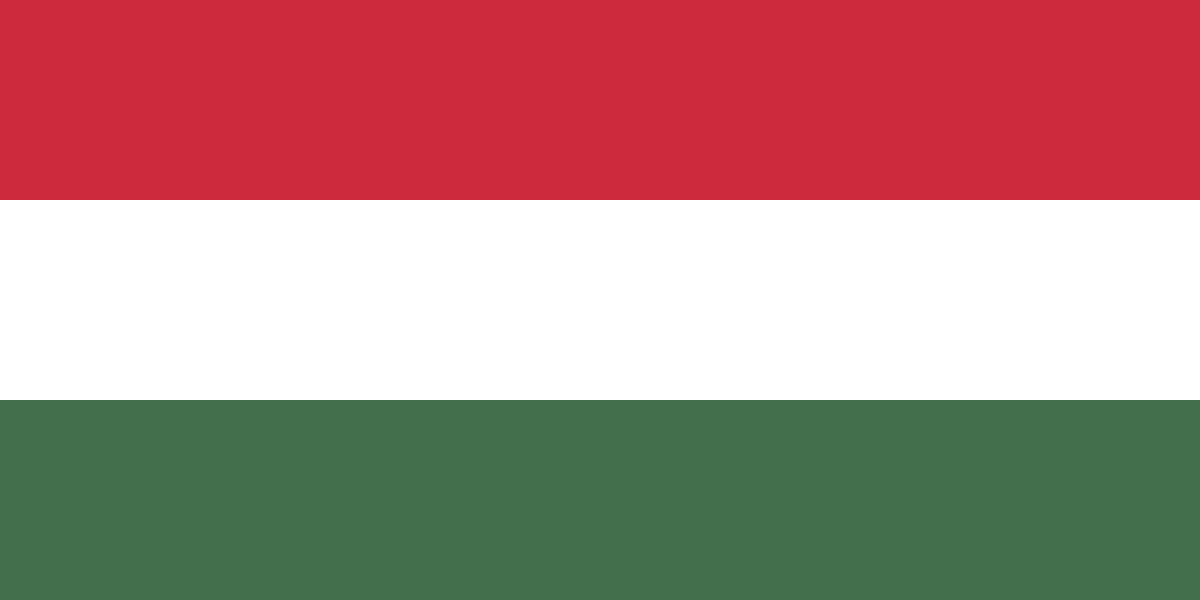
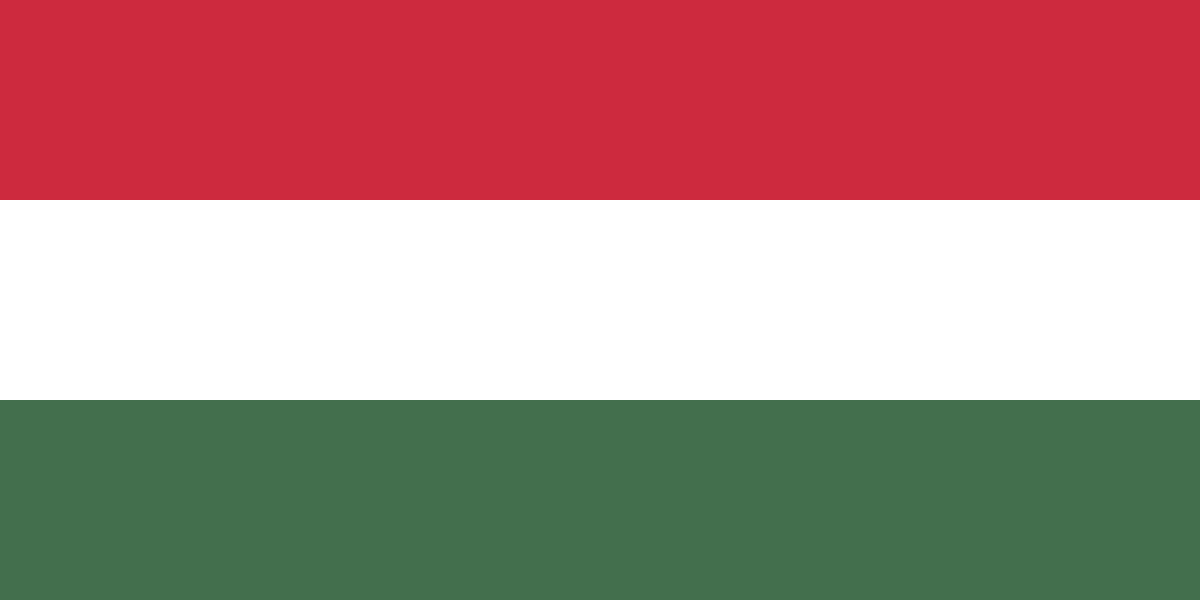
Hungary's flag has three stripes: red, white and green. All three stripes are the same width. It has a simple design with no picture in the middle.

Hungary's flag has three level stripes of equal width - red, white and green from the top. These three colors were set as the nation's colors by a law made in 1848. Hungary's constitution defines the flag as three equal horizontal stripes of red, white and green. Under government rules, its width is twice its height. With no coat of arms in the middle, its simple design lets the three stripes stand out clearly even from far away.