World Geography Atlas › Europe › Southern Europe

Spain

España

The country of flamenco and Gaudí's architecture.

Capital MadridPopulation About 48 millionArea 505,990 km²Language Spanish
Map

Reading the land

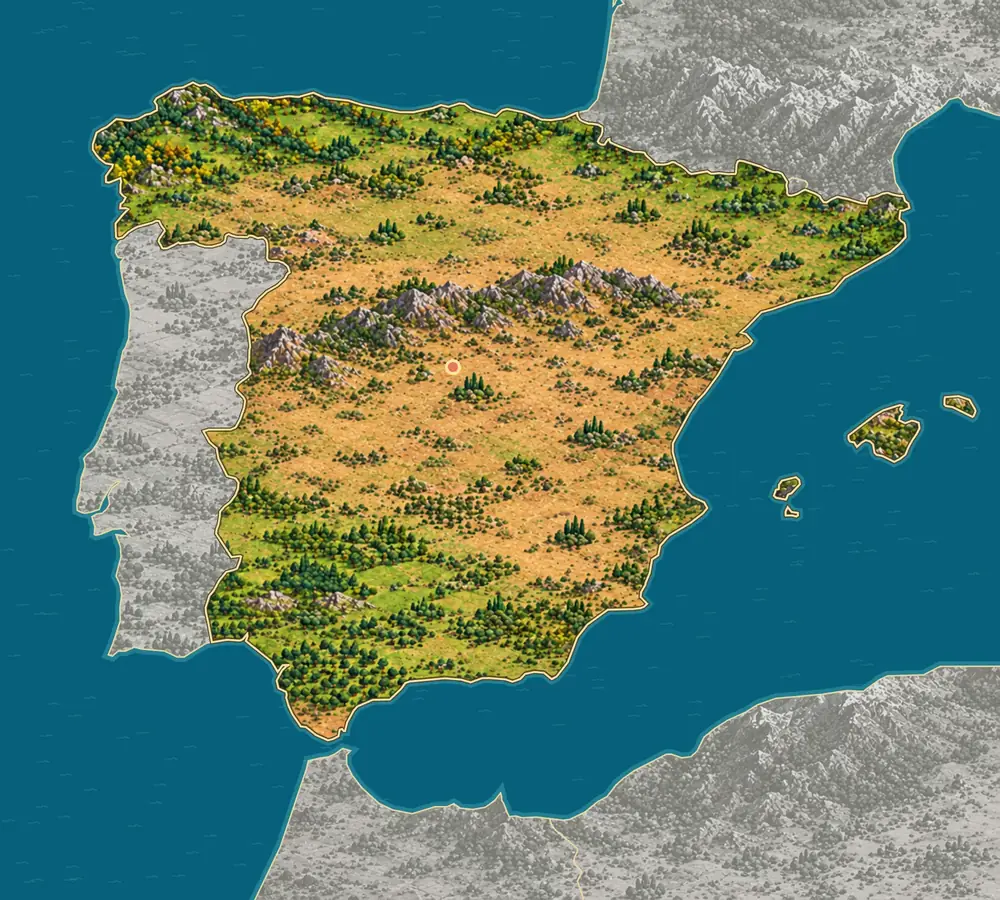
Illustrated map of Spain
Illustrated map: yenalab. Country outlines: Natural Earth (public domain).

Spain has a wide, high, flat land in its middle. The northern coast is rainy and green, while the middle and south dry out in summer. The volcanic Canary Islands, far out at sea, are also part of Spain.

Mainland Spain is made up of the central Meseta plateau, the mountains around it and the low valleys of the Ebro and Guadalquivir rivers. It also includes the Balearic Islands in the Mediterranean and the Canary Islands in the Atlantic.

Terrain

Mountains across the plateau

A mountain chain called the Sistema Central crosses the middle of the Meseta and splits it into a northern and a southern half. The low valleys of the Ebro in the northeast and the Guadalquivir in the south lie between the plateau and the outer ranges.

Source: La Moncloa (Government of Spain), Geography of Spain

Coasts & islands

A long coast on two seas

Spain's coastline is 5,755 km long. The rainy, green north and west face the Atlantic, the east and south, dry in summer, face the Mediterranean, and in the Mediterranean lie the Balearic Islands, including Majorca.

Source: La Moncloa (Government of Spain), Geography of Spain

Doñana at the river mouth

Where the Guadalquivir meets the Atlantic lies Doñana, a wide wetland. Sand and mud carried by the river and the wind built marshes, lagoons and dunes, and more than 500,000 waterbirds spend the winter there each year.

Source: UNESCO, Doñana National Park

Geology

Teide in the Canary Islands

The Canary Islands, in the Atlantic west of Africa, were built by volcanoes. Mount Teide on Tenerife is 3,718 m high, the highest point in Spain, and about 7,500 m tall when measured from the ocean floor.

Source: UNESCO, Teide National Park

Limestone of the Pyrenees

The Monte Perdido area of the Pyrenees, on the northern border with France, is a limestone massif. Its summit (3,352 m) is on the Spanish side, and glaciers and water have carved deep canyons into it.

Source: UNESCO, Pyrénées - Mont Perdu

Collection

Spain Collection

A city, a heritage site, nature, a plant, culture, food, an animal, a greeting and the flag of Spain, each drawn as pixel art.

Madrid
City

Madrid

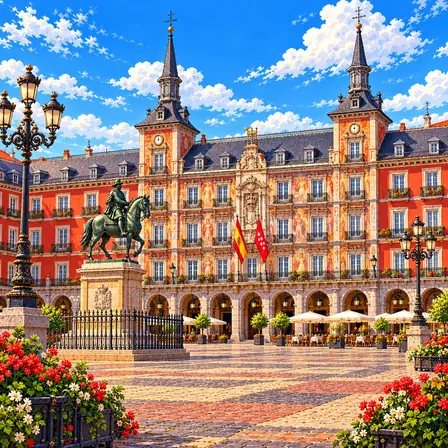
Madrid is the capital of Spain. It sits higher above the sea than any other capital in Europe. It has a big museum full of famous paintings.

Madrid is the capital of Spain, where about 3.4 million people live. It began as a small fortress built by the Moors in the 9th century, and Philip II made it the capital in 1561. At about 650 m above sea level, it is the highest capital in the European Union. It has the royal palace and the Prado Museum, one of the world's great art museums, and it was shaped by Baroque city planning in the 17th and 18th centuries.

Alhambra
Heritage

Alhambra

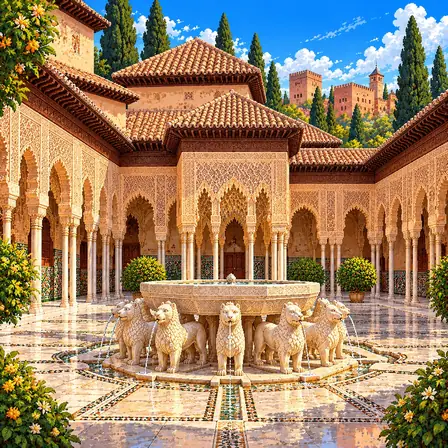
The Alhambra is an Islamic palace built about 700 years ago. Its walls and ceilings are covered with delicate patterns and tiles. Water flows all through the palace without any pumps.

The Alhambra is an Islamic palace of the Nasrid dynasty (13th-15th century) in Granada, Spain. It was the heart of the last Islamic kingdom on the Iberian Peninsula until 1492. Its arabesque patterns, geometric tiles, and muqarnas ceilings join mathematical precision with art. The water system of the Court of the Lions is clever engineering that supplies the whole palace with water using gravity alone.

Montserrat
Nature

Montserrat

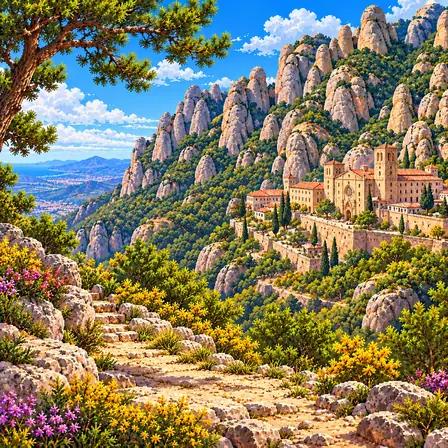
Montserrat is a rocky mountain with jagged peaks like the teeth of a saw. Rain and wind shaped the rock over a very long time. An old monastery sits halfway up the mountain.

Montserrat is a mountain of strange rock cliffs near Barcelona. Layers of conglomerate, gravel brought by rivers about 40 million years ago that hardened into rock, were lifted up, and then rain and wind wore the hard conglomerate and softer rock at different rates, forming saw-toothed peaks. The Benedictine monastery on the mountainside has been a holy place of Catalonia since the 9th century, and a Black Madonna statue is kept there.

Olive Tree
Plants

Olive Tree

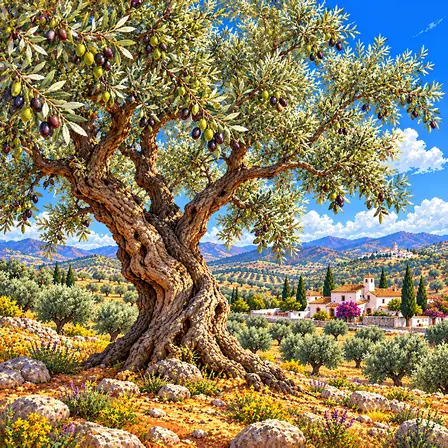
The olive tree has silvery leaves and small fruit. Spain makes more olive oil than any other country. Some trees hundreds of years old still bear fruit today.

The olive tree is a tree that stands for Andalusia in southern Spain and the Mediterranean. Known for its silvery leaves and small, hard fruit, Spain is the world's largest producer of olive oil. Olive trees hundreds of years old still bear fruit. Since ancient times it has been a symbol of peace, wisdom, and prosperity, and it is a key ingredient of Spanish food culture.

Flamenco Dress
Culture

Flamenco Dress

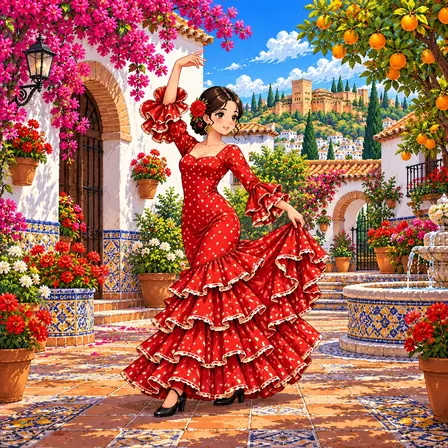
The flamenco dress is worn for flamenco dancing. Its wavy ruffles swirl out as the dancer moves. Dancers also carry fans and wear flowers in their hair.

The flamenco dress is the costume for the flamenco dance, born in Andalusia in southern Spain. The frilled hem, fitted on the body and then rippling out below the knee, spreads open beautifully with the dance moves. Flamenco - an art that brings together singing, guitar playing, dancing, and hand-clapping rhythms - was listed as a UNESCO Intangible Cultural Heritage in 2010. The dancer adds style with a fan and a flower set in the hair. At the April Seville Fair, you can meet streets full of people in flamenco dresses.

Paella
Food

Paella

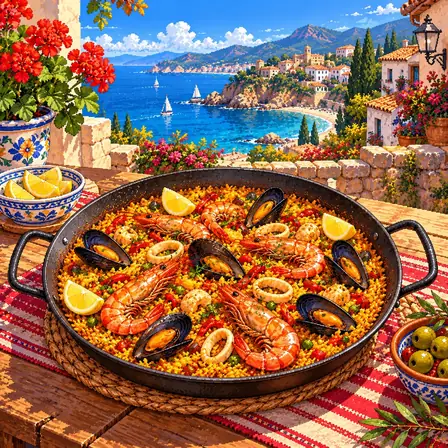
Paella is rice cooked with seafood in a wide pan. A spice called saffron turns the rice yellow. The crispy rice stuck to the bottom of the pan is said to be the tastiest part.

Paella is a rice dish from the Valencia region of Spain, made by cooking rice with seafood and vegetables in a wide, shallow pan. Its name comes from the name of the pan used to cook it. A spice called saffron dyes the rice yellow and adds its special scent. Seafood paella topped with shrimp and mussels is famous, but the original Valencian style uses chicken and rabbit. The crispy layer stuck to the bottom of the pan, called socarrat, is counted as the tastiest part.

Iberian Lynx
Animals

Iberian Lynx

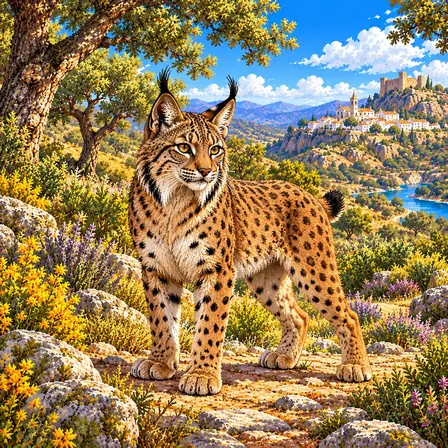
The Iberian lynx is a wild cat with black tufts on its ear tips like little brushes. Once fewer than 100 were left, but with people's help there are now more than 2,000. Rabbits are its main food.

The Iberian lynx is a member of the cat family with black tufts on the tips of its ears and whisker-like fur on its cheeks. It lives only in the scrub forests of the Iberian Peninsula, in Spain and Portugal. Most of its food is rabbits, so it is a fussy hunter that is in danger whenever rabbits become scarce. In 2002 fewer than 100 were left, making it the most endangered cat in the world, but efforts to raise rabbits and restore the wild have brought it back to more than 2,000. It is held up as a famous success story in protecting endangered species.
Hola
Greeting

Hola

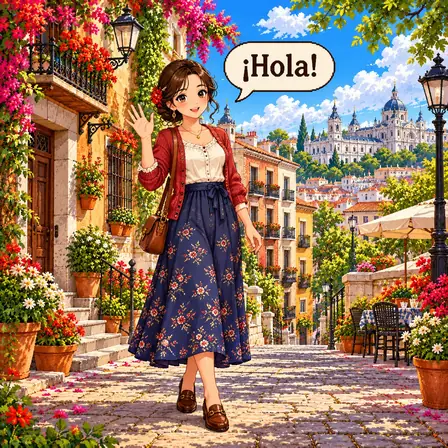
¡Hola! means "hello" in Spanish. The H is silent, so you say "ola." Spanish puts an upside-down exclamation mark at the start of a sentence.

"¡Hola!" is a Spanish greeting, read "OH-lah." The H is a silent letter, so it is "ola," not "hola." Spanish is a Romance language that grew from Latin, with about 500 million native speakers - the second most in the world. It is an official language in about 20 countries, including Spain and many in Latin America. It uses an unusual way of writing found in few places: an upside-down exclamation mark (¡) placed at the start of a sentence.

Spain's Flag
Flag

Spain's Flag

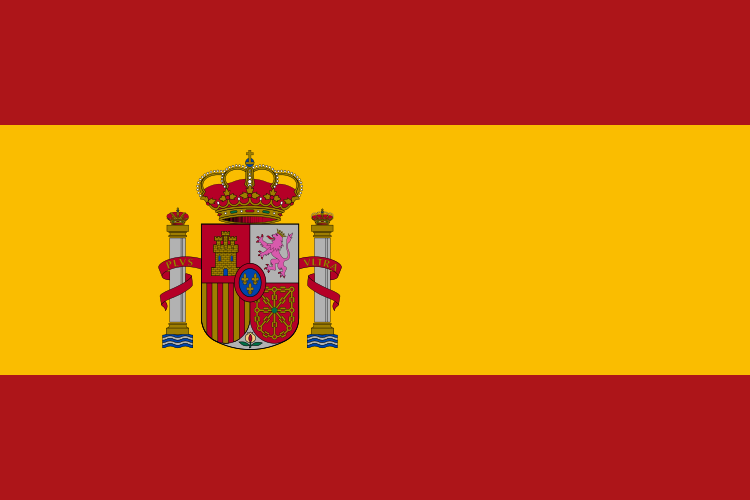
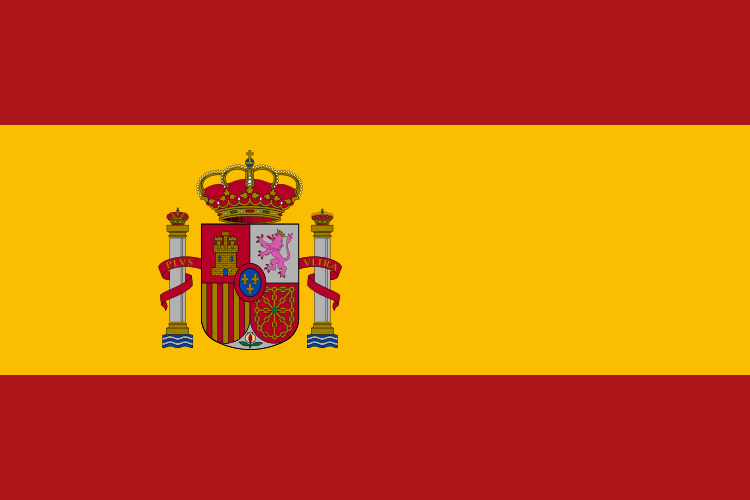
Spain's flag has three stripes: red, yellow and red. The yellow stripe in the middle is twice as wide. On the left of the yellow stripe is the country's coat of arms.

Spain's flag has a yellow stripe twice as wide between red stripes at the top and bottom. On the left of the yellow stripe is a national emblem that gathers the coats of arms of old kingdoms. Red and yellow began when King Charles III chose, in 1785, colors that could be seen well from far out at sea. The two pillars in the emblem are the legendary "Pillars of Hercules" of the Strait of Gibraltar. Because the yellow is so wide, it has the nickname "la rojigualda" (the red-and-gold flag).

Sources