World Geography Atlas › North America › Caribbean

Cuba

Cuba

The largest island country in the Caribbean · rumba and the world's smallest bird.

Capital HavanaPopulation About 9.7 millionArea 109,884 km²Language Spanish
Map

Reading the land

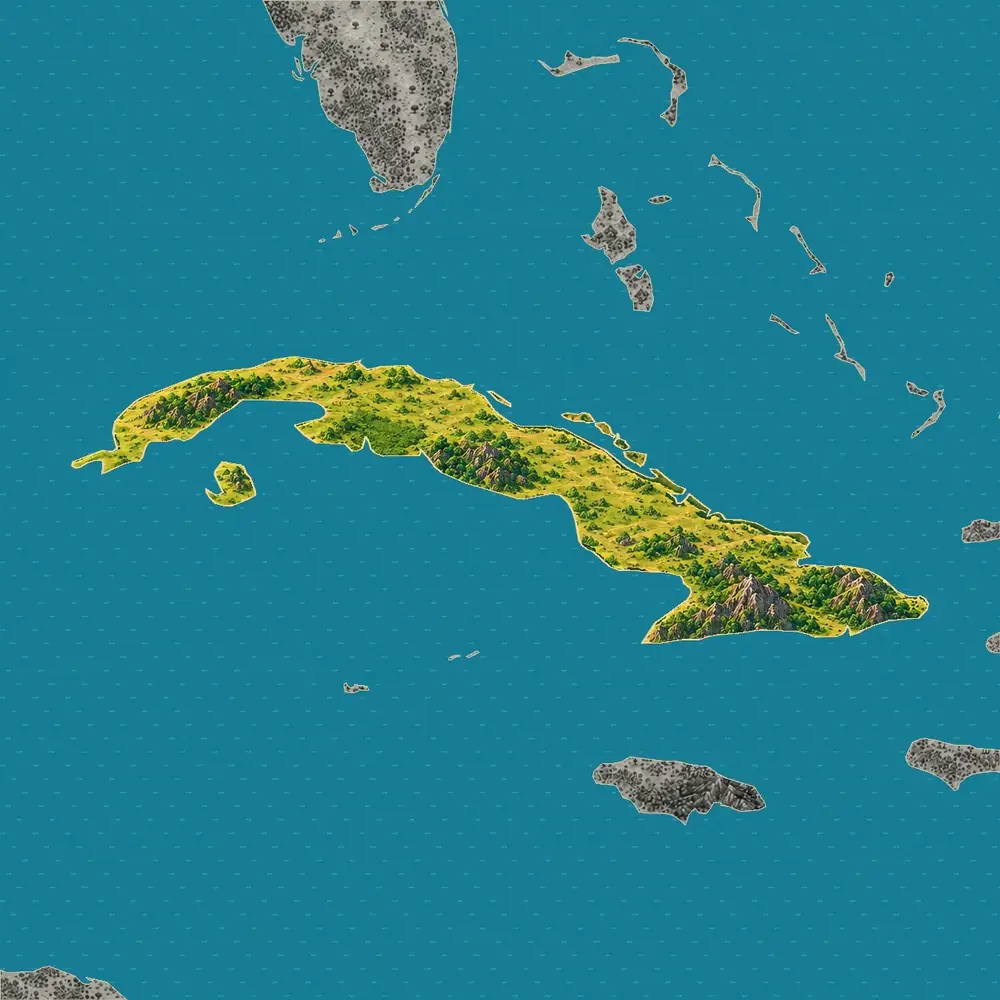
Illustrated map of Cuba
Illustrated map: yenalab. Country outlines: Natural Earth (public domain).

Cuba is made up of one long island stretching east to west and many smaller islands. Most of the land is low, flat countryside. Forested mountains rise in the west, the middle and the east.

Cuba is made up of the large main island, the Isla de la Juventud to the southwest and many small islands along its coasts. Between low plains rise the Sierra de los Órganos in the west, the Escambray in the middle and the Sierra Maestra in the southeast.

Terrain

Three mountain areas among the lowlands

Most of the main island is low plains and gentle hills, and the mountains sit in three separate areas in the west, the middle and the southeast. The Sierra Maestra runs along the southeastern coast right beside the sea, and at its western end it drops straight into the sea as cliffs.

Source: UNESCO, Desembarco del Granma National Park

The rounded hills of Viñales

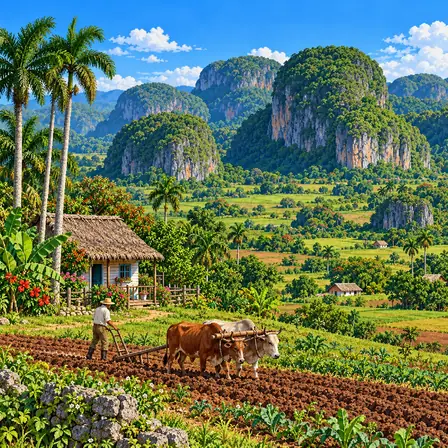
In the Viñales Valley at the foot of the western Sierra de los Órganos, steep dome-shaped hills called mogotes rise like islands from the flat valley floor. Farmers still work the valley in traditional ways, and it became a UNESCO World Heritage site in 1999.

Source: UNESCO, Viñales Valley

Sea & islands

Clear water and coral reefs

Many small islands are scattered around Cuba's main island. Off Cabo Cruz at the southeastern tip the water is very clear, and coral reefs grow out toward the open sea.

Source: UNESCO, Desembarco del Granma National Park

The largest wetland in the Caribbean

The Zapata Swamp on the south coast covers about 4,500 km² and is the largest and best-preserved wetland in the Caribbean. Its mangrove forests, marshes and shallow waters are home to migrating birds and birds found only in Cuba.

Source: Ramsar Convention, Ciénaga de Zapata (Ramsar Site 1062)

Geology

Steps of land raised from the sea

Around Cabo Cruz in the southeast, limestone formed under the sea was slowly lifted up while the sea level changed many times, leaving the land in layers like a staircase. These steps run from 180 m below sea level to 360 m above it, and the area became a UNESCO World Heritage site in 1999.

Source: UNESCO, Desembarco del Granma National Park

Collection

Cuba Collection

A city, a heritage site, nature, a plant, culture, food, an animal, a greeting and the flag of Cuba, each drawn as pixel art.

Havana
City

Havana

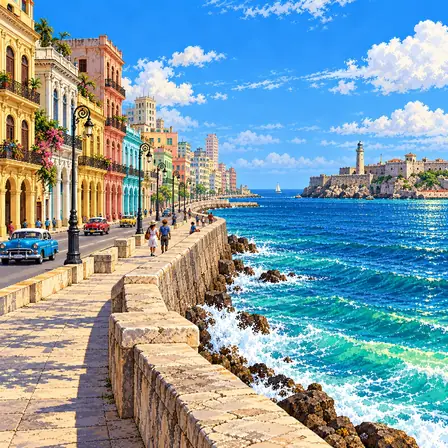
Havana is the capital of Cuba. Colorful old buildings and forts line the seaside. A long seawall road called the Malecón runs along the sea.

Havana is the capital of Cuba, on the northwest coast of the island beside a harbor with a narrow mouth and a wide inner bay. Ships sailing between the Americas and Europe stopped in this harbor, sheltered from wind and waves, and the city grew large. Old Havana, where the forts that guarded the harbor mouth and Baroque and Neoclassical buildings still stand, was inscribed on the UNESCO World Heritage List in 1982. The Malecón, a seawall road that runs a long way along the shore, is where people rest and gaze out at the sea. With about 2 million people, it is one of the largest cities in the Caribbean.

San Pedro de la Roca Castle
Heritage

San Pedro de la Roca Castle

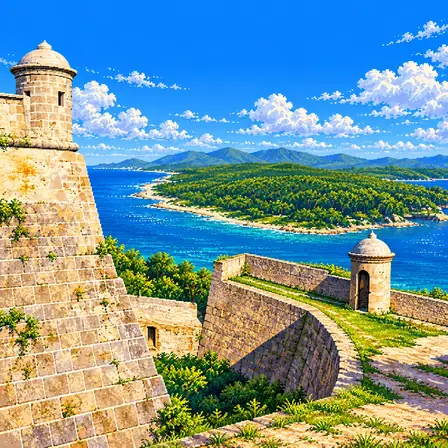
San Pedro de la Roca Castle is a stone fortress built on a seaside cliff. It was stacked level by level up a rocky slope to keep out pirates long ago. Today it is a museum and a World Heritage site.

San Pedro de la Roca Castle is a stone fortress built on a rocky cliff at the mouth of Santiago de Cuba Bay in southeastern Cuba. It was designed by Antonelli, a military engineer from Italy, to keep out pirates attacking from the sea, and building began in 1638 and went on for a long time, until around 1700. Gun platforms, walls and powder rooms were stacked in several levels down the rocky slope and linked by stairs, so every level looked down on the mouth of the bay. It is counted as the best-preserved and most complete example of the military buildings Spain built in the Americas, and it was inscribed on the UNESCO World Heritage List in 1997. Today it is a museum, and people look out over the sea from its walls.

Viñales Valley
Nature

Viñales Valley

The Viñales Valley is a valley where round rocky peaks rise up here and there. Rainwater shaped them by dissolving limestone for a very long time. On the valley floor, oxen plow the fields.

The Viñales Valley is a wide valley ringed by the Sierra de los Órganos in western Cuba. The ground here is limestone, and over a very long time rainwater dissolved and wore it away, leaving only steep, dome-shaped peaks called mogotes standing like islands. Some mogotes rise as high as 300 m, and inside them are many caves carved by rainwater. On the flat valley floor, farmers still work the fields the old way, with plows pulled by oxen, and farmhouses built of wood and palm leaves are scattered about. As a landscape where nature and people's lives blend together, it was inscribed on the UNESCO World Heritage List in 1999.

Royal Palm
Plants

Royal Palm

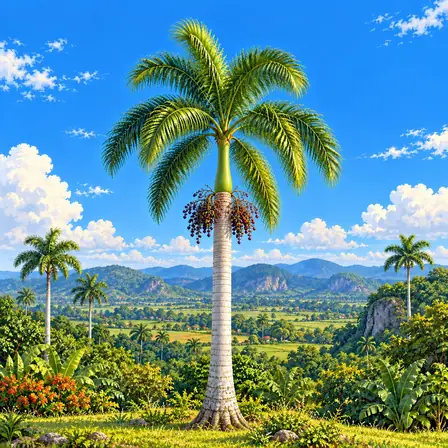
The royal palm is a palm tree that grows straight up toward the sky. A green column and feathery leaves sit on top of its smooth gray trunk. It can be seen in fields all over Cuba.

The royal palm is a tall palm tree often seen in Cuba's fields and along its roads. Its smooth, gray-white trunk grows straight up to 20-30 m, and at the top of the trunk is a smooth green column formed by leaf stalks wrapped tightly around one another. Above it, feather-shaped leaves several meters long spread out in a round crown. After clusters of small flowers bloom, bunches of pea-sized fruits form, and birds and bats eat the fruit and spread the seeds. For a long time, Cubans have used its broad leaf stalks and leaves to cover the roofs of farmhouses.

Rumba
Culture

Rumba

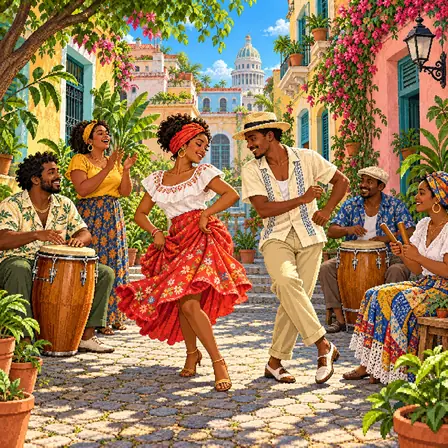
Rumba is Cuban music that brings together drums, song and dance. When drums and wooden sticks make the rhythm, people sing and dance. It is part of UNESCO's Intangible Cultural Heritage.

Rumba is Cuban music in which drums, song and dance come together as one. It arose in the 19th century in port neighborhoods of Havana and Matanzas, where drum rhythms carried over from Africa met Spanish singing traditions. When drums of different sizes, called congas, and a pair of wooden sticks, called claves, weave the rhythm, a lead singer sings a story and everyone sings back and dances. It has three styles: the relaxed yambú, the guaguancó danced by a couple, and the quick columbia danced alone. It was inscribed on UNESCO's list of the Intangible Cultural Heritage of Humanity in 2016.
Ropa Vieja
Food

Ropa Vieja

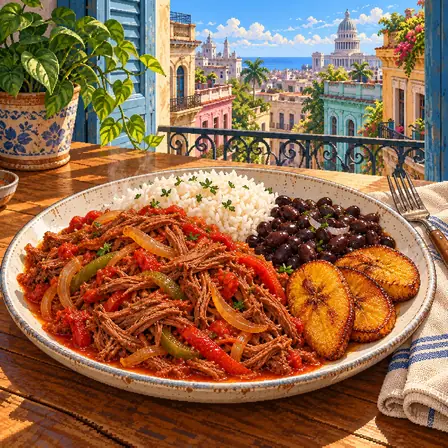
Ropa vieja is beef pulled into thin shreds and cooked in tomato sauce. Its name means "old clothes." It got the name because the shredded meat looks like worn-out clothes.

Ropa vieja is a Cuban meat dish made by simmering beef until tender, pulling it into thin shreds along the grain, and cooking it again in tomato sauce. Its name means "old clothes" in Spanish, said to come from the way the shredded meat looks like worn-out cloth. Onion, garlic and green pepper are fried in oil to make a base called sofrito, and tomato is added so the flavor soaks into the meat. It seems to have been brought by people who came from Spain's Canary Islands, and in Cuba it first appears in a record from 1857. It is eaten with white rice, black beans and fried plantains, a kind of cooking banana.

Bee Hummingbird
Animals

Bee Hummingbird

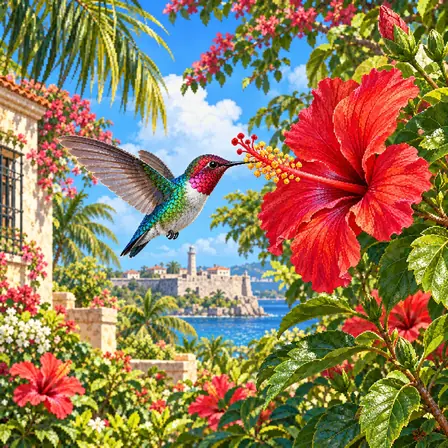
The bee hummingbird is the smallest bird in the world. It is only about as long as a grown-up's thumb. It hovers in the air and sips nectar from flowers.

The bee hummingbird lives only on the island of Cuba and the Isle of Youth, and it is the smallest bird in the world. A male is about 5.5 cm long and weighs less than 2 g, only a little bigger than a large bee. Beating its wings dozens of times a second, it hovers in the air, dips its thin bill into flowers to sip nectar, and also catches tiny insects. In the breeding season, the male's head and throat turn a shimmering red. Its nest is tiny, only about 2.5 cm across, and in it the female lays two pea-sized eggs.

¡Hola!
Greeting

¡Hola!

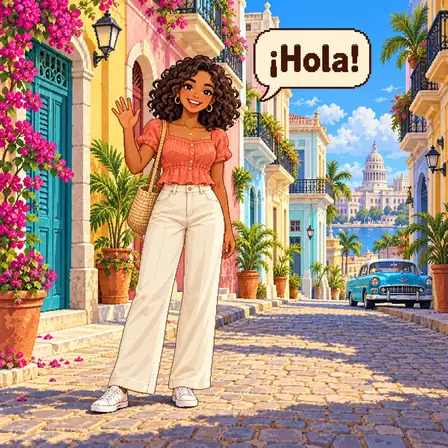
¡Hola! means "hello" in Spanish. The h is silent, so it is read "oh-la." Cubans greet their friends with a cheerful hola.

¡Hola!, read "oh-la," is a Spanish greeting used any time of day when people meet. Spanish does not pronounce the letter h, so it is read "oh-la," not "ho-la." Cubans often soften or drop the s at the end of a word or before a consonant, so even though it is the same Spanish language, it sounds different from Spain's. Spanish sentences do not just put exclamation and question marks at the end; they also start with upside-down marks (¡, ¿). Most Cubans speak Spanish, and around the world about 500 million people speak it as their first language.

Cuba's Flag
Flag

Cuba's Flag

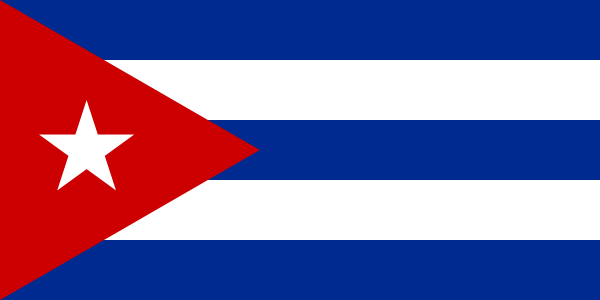
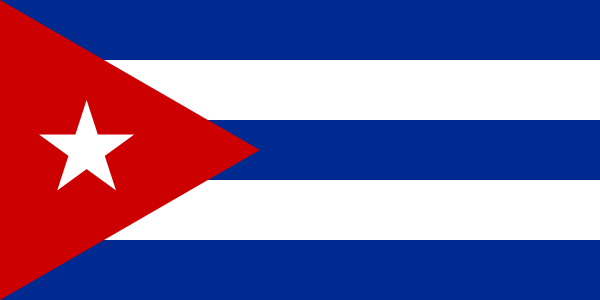
Cuba's flag has five blue and white stripes and a red triangle. There is one white star in the triangle. People call it the Lone Star.

Cuba's flag is made of five horizontal stripes, three blue and two white in turn, and a red triangle on the side nearest the pole. In the middle of the red triangle is a single white star, so the flag is called the Lone Star, or Estrella Solitaria. The design was first made in 1849, and it became the national flag in 1902, when the Republic of Cuba was founded. Cuba's constitution names this flag, together with the coat of arms and the national anthem, as a symbol of the nation. Its width is twice its height.