World Geography Atlas › Africa › Central Africa

Cameroon

Cameroun

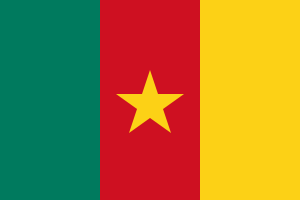
Called "Africa in miniature" · a green, red and yellow flag.

Capital YaoundéPopulation About 29 millionArea 475,442 km²Language French and English
Map

Reading the land

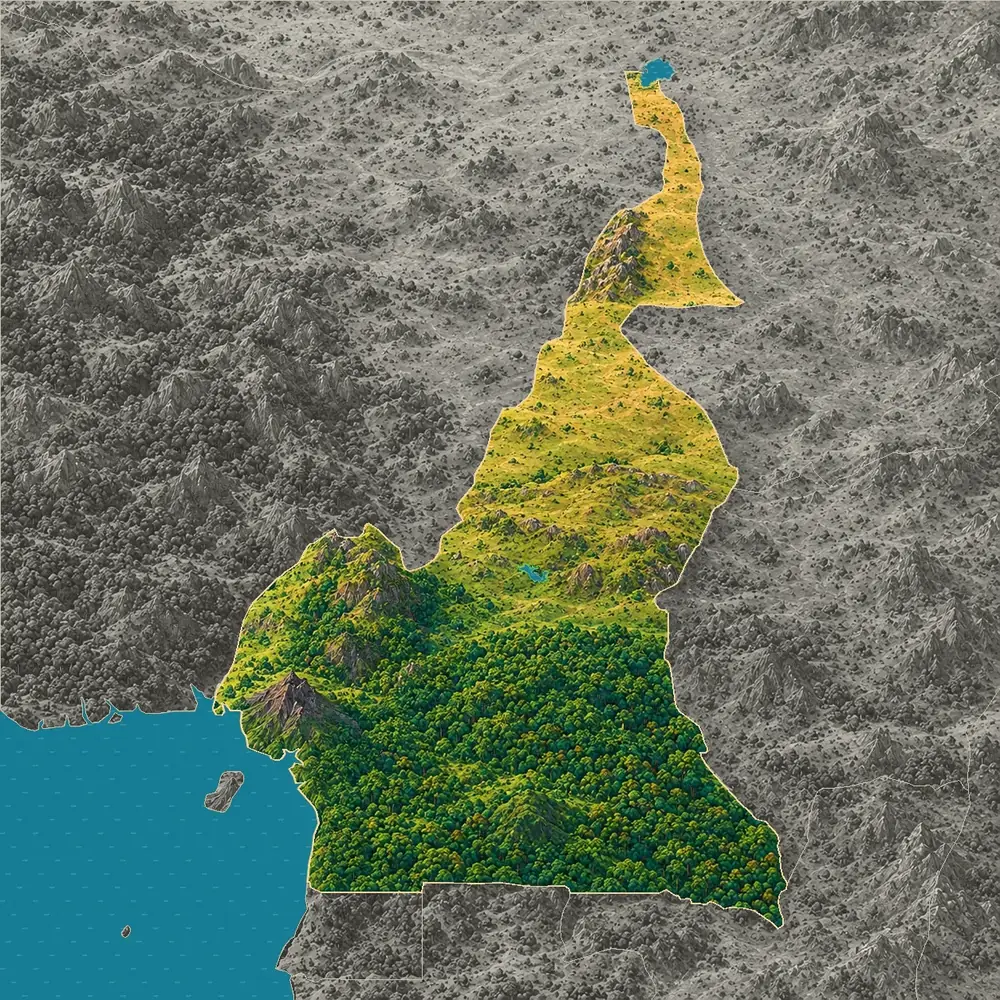
Illustrated map of Cameroon
Illustrated map: yenalab. Country outlines: Natural Earth (public domain).

Southern Cameroon is dense rainforest, and grassland and dry land spread out the farther north you go. On the western coast rises Mount Cameroon, a volcano that still erupts. The northern tip reaches Lake Chad.

Cameroon runs from rainforest in the south through the Adamawa Plateau in the middle to savanna in the north. In the west, Mount Cameroon and other highlands rise along a chain of volcanoes that runs north from an island in the Gulf of Guinea.

Terrain

Wide rainforest in the south

The south of Cameroon is covered by rainforest that continues into the heart of Africa. Within it, the Dja Faunal Reserve covers about 5,260 km² and is almost completely encircled by the Dja River. It is one of the largest and best-protected rainforests in Africa and a UNESCO World Heritage site.

Source: UNESCO, Dja Faunal Reserve

Water & sea

Geology

A chain of volcanoes from the sea

The highlands of western Cameroon formed along a chain of volcanoes running north from Bioko Island in the Gulf of Guinea. Magma rose along cracks in the Earth's crust and built Mount Cameroon and the volcanoes of the western highlands.

Source: Encyclopaedia Britannica, Cameroon: Land

Collection

Cameroon Collection

A city, a heritage site, nature, a plant, culture, food, an animal, a greeting and the flag of Cameroon, each drawn as pixel art.

Yaoundé
City

Yaoundé

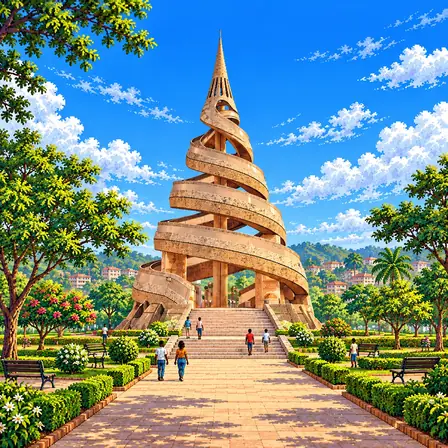
Yaoundé is the capital of Cameroon. It has many hills, so it is called the City of Seven Hills. A monument shaped like winding spirals is its best-known landmark.

Yaoundé is the capital of Cameroon, set on high ground about 750 m above sea level in the south-central part of the country. The city spreads over several hills and the valleys between them, so it is called the City of Seven Hills. It became the capital when Cameroon became independent in 1960. On a hill in the middle of the city stands the Reunification Monument, built in the 1970s in the shape of two spirals winding upward, and it has become Yaoundé's best-known landmark. With about 3.8 million people, it is Cameroon's second-largest city, after the seaport of Douala.

Foumban Royal Palace
Heritage

Foumban Royal Palace

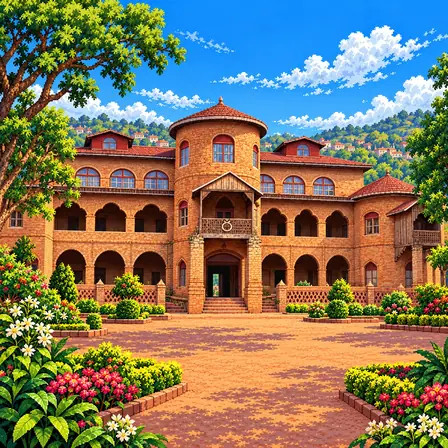
The Foumban Royal Palace is where the king of the Bamum Kingdom lives. It was built in 1917 and has a museum inside. A king of this kingdom invented his own script.

The Foumban Royal Palace is the palace of the Bamum Kingdom in the town of Foumban, on the western highlands of Cameroon. It was built in 1917 by the Bamum king Ibrahim Njoya, a two-story brick building with arched windows, long galleries and tall towers. In the late 19th century, King Njoya invented his own script for writing the Bamum language, and he had books written in it about the kingdom's history, laws and medicine. The Bamum king still lives in the palace today, and a museum there shows clothing, carvings and musical instruments of a royal line that goes back to the late 14th century. The Bamum people still hold traditional events in the square in front of the palace.

Mount Cameroon
Nature

Mount Cameroon

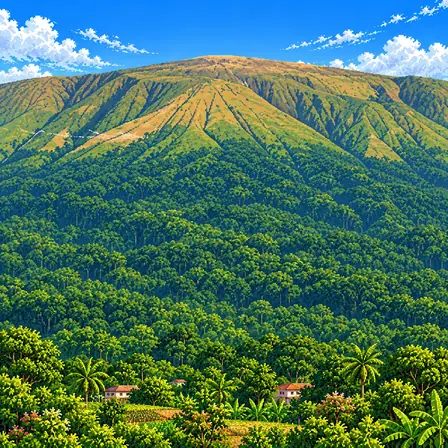
Mount Cameroon is the highest mountain in West and Central Africa. It is a volcano that is still active. Its foot is one of the rainiest places in the world.

Mount Cameroon rises straight up from the southwest coast of Cameroon and is the highest mountain in West and Central Africa. It is a volcano built up as magma rose through cracks in the ground and layers of lava and ash piled up again and again, and it stands about 4,095 m tall. It is still active, and lava flowed down its slopes as recently as 1999. Damp winds from the sea hit the mountain and drop heavy rain, so Debundscha, at its western foot, gets about 10 m of rain a year and is one of the rainiest places on Earth. From its foot upward come rainforest, mountain forest and grassland in turn, and it is protected as Mount Cameroon National Park.

Bitter Leaf
Plants

Bitter Leaf

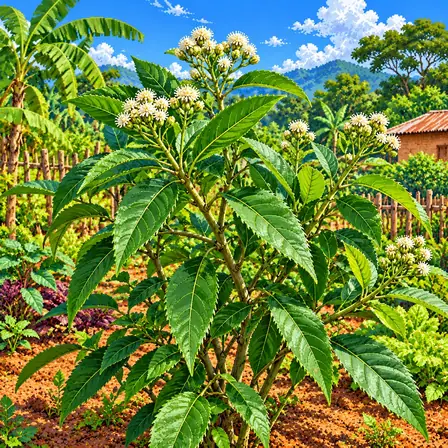
Bitter leaf is a plant whose leaves taste very bitter when chewed. The leaves are washed and boiled several times to soften the bitterness before eating. It goes into the Cameroonian dish ndolé.

Bitter leaf is a shrub of the daisy family often grown in fields and around homes in Cameroon's villages. It grows 2-5 m tall, and its dark green leaves are long ovals with pointed tips that taste very bitter when chewed, which is how it got its name. Small white flowers bloom in clusters at the ends of its branches, and a cut branch stuck in the ground will root and grow easily. The leaves are washed and boiled several times to soften their bitterness and eaten as a vegetable, and they are the main ingredient of ndolé, a well-known Cameroonian dish. In many countries of West and Central Africa, it has long been used as a vegetable and a traditional medicine.

Beaded Elephant Mask
Culture

Beaded Elephant Mask

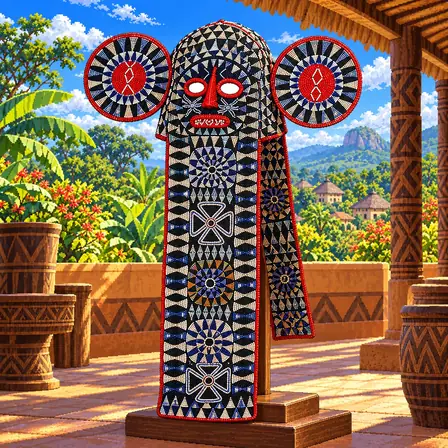
The beaded elephant mask is covered in colorful glass beads. Its long panels are the elephant's trunk, and the round panels are its ears. At ceremonies, people wear it and dance to drums.

The beaded elephant mask is worn by the Bamileke people of the Grassfields, the western highlands of Cameroon. Countless glass beads are sewn onto cloth: long panels hanging down the front and back stand for an elephant's trunk, and round panels on the sides stand for its ears. Beads were precious goods brought from far away, so the more beads a mask had, the higher the rank of its wearer it showed. At great ceremonies and funerals, members of the Kuosi society, made up of royal relatives and notable people, wear these masks and dance slowly to the sound of drums and gongs. As they dance, the round ears flap so that it looks as if an elephant is moving.
Ndolé
Food

Ndolé

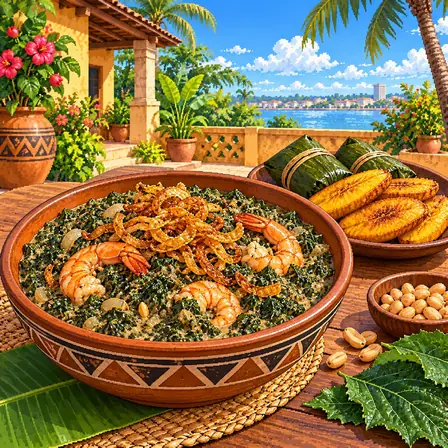
Ndolé is a Cameroonian dish of bitter leaf cooked with peanuts. Meat or shrimp is added for flavor. People eat it with plantains or rice.

Ndolé is a well-known Cameroonian dish of bitter leaf cooked in a peanut sauce. The bitter leaves are washed and boiled several times to soften their bitterness, then cooked with boiled, finely ground peanuts, onion and garlic until thick. Beef, fish or shrimp is added for flavor, and fried onion and shrimp are sometimes placed on top at the end. It is said to have begun as a dish of the Sawa people of the coastal city of Douala, and today people all over Cameroon enjoy it on special days. It is eaten with bobolo, a fermented and steamed cassava, or with plantains or rice.

Goliath Frog
Animals

Goliath Frog

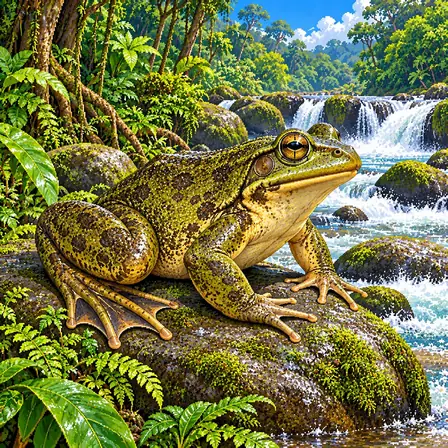
The Goliath frog is the largest frog in the world. It can weigh more than 3 kg, as big as a cat. It moves stones on the riverbank to make round pool nests.

The Goliath frog lives only around fast-flowing rivers and waterfalls in southwestern Cameroon and Equatorial Guinea, and it is the largest frog in the world. It can grow up to about 32 cm long and weigh more than 3 kg, as big as a cat. It spends its time on rocks in strong currents and catches insects, crayfish, small fish and other frogs. It pushes stones on the riverbank aside to make round pool nests more than 1 m across and lays its eggs inside them. As its forests have shrunk and many have been caught by people, its numbers have fallen sharply, and it is protected as an endangered species.

Bonjour! / Hello!
Greeting

Bonjour! / Hello!

In Cameroon, people say "Bonjour" in French and "Hello" in English. Both are official languages. There are also more than 250 other languages.

Cameroon uses both French and English as official languages, so people greet each other with both the French "Bonjour" and the English "Hello." French is used mainly in most of the country, and English mainly in two regions in the west. The constitution says the two languages have equal standing, so both appear together on banknotes and government documents. Beyond these, Cameroon has more than 250 local languages. In markets and on the streets, Cameroonian Pidgin English, which grew out of English, is also often heard.

Cameroon's Flag
Flag

Cameroon's Flag

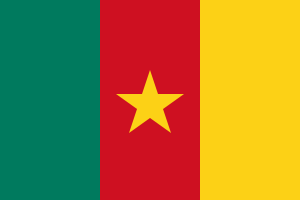
Cameroon's flag has three vertical bands: green, red and yellow. There is one yellow star in the red band. The star stands for a united nation.

Cameroon's flag has three vertical bands, green, red and yellow from the left, with a single yellow star in the middle red band. The three-color flag was first adopted in 1957, two stars were added in 1961, and on May 20, 1975, the stars were changed to one. The single star is said to stand for the unity of the nation. Cameroon's constitution defines the flag as three vertical bands of green, red and yellow with a yellow star in the middle. Its width-to-height ratio is 3:2.