World Geography Atlas › South America › South America

Brazil

Brasil

The Amazon River and the country of soccer · Carnival.

Capital BrasíliaPopulation About 210 millionArea 8,515,767 km²Language Portuguese
Map

Reading the land

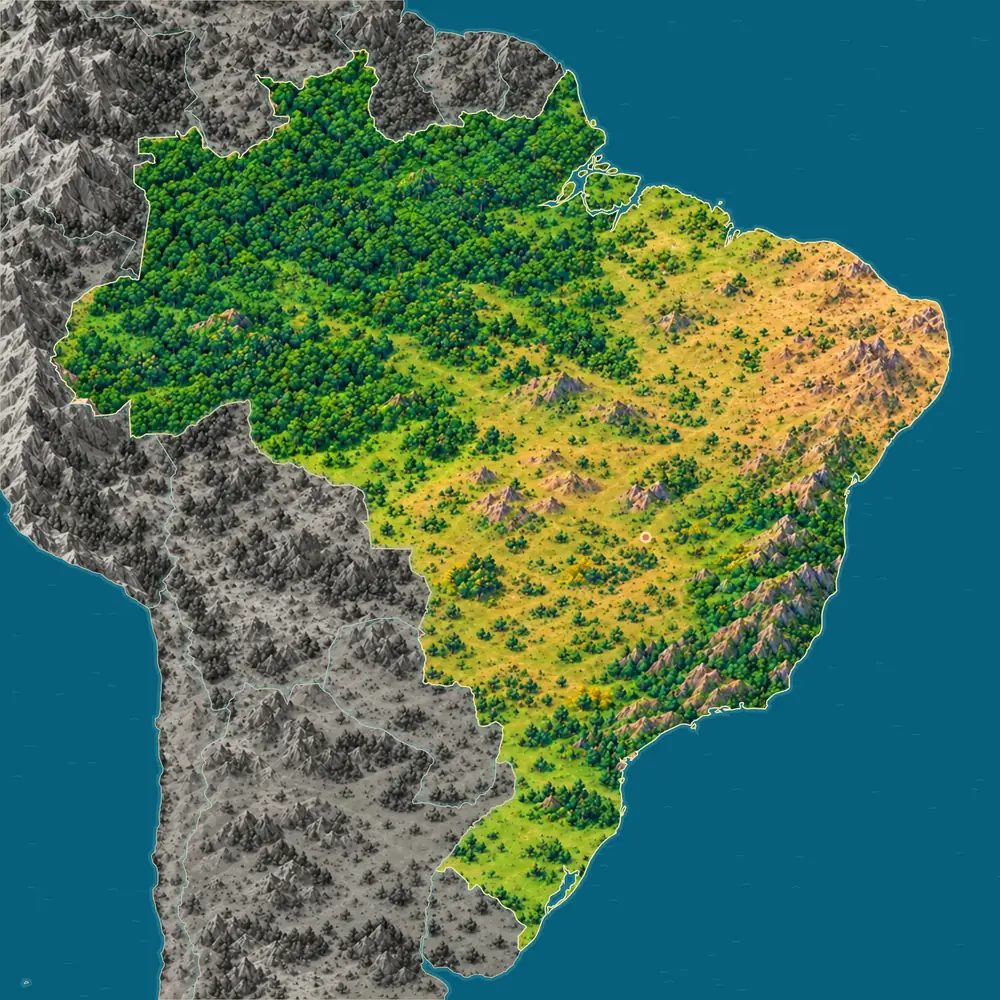
Illustrated map of Brazil
Illustrated map: yenalab. Country outlines: Natural Earth (public domain).

Northern Brazil is a vast tropical forest around the Amazon River. The middle is high land with grass and short trees. The eastern tip gets little rain and is dry.

41% of Brazil lies below 200 m, mostly in the Amazon basin. The Central Plateau in the middle averages 1,000 m, and mountains line the Atlantic coast.

Terrain

Rivers & forests

Geology

Collection

Brazil Collection

A city, a heritage site, nature, a plant, culture, food, an animal, a greeting and the flag of Brazil, each drawn as pixel art.

Brasília
City

Brasília

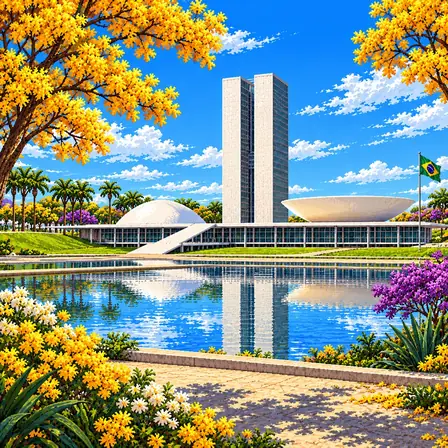
Brasília is the capital of Brazil. It was built in the middle of the country about 60 years ago. From above, the city is shaped like an airplane.

Brasília is the planned capital of Brazil, built inland in 1960. The architect Oscar Niemeyer and the city planner Lúcio Costa worked together to design it in the shape of an airplane. Modern architectural masterpieces gather here, such as the twin domes of the National Congress, the presidential palace, and the Supreme Court. It is a rare case, listed as a UNESCO World Cultural Heritage site in 1987, just 27 years after it was founded.

Historic Town of Ouro Preto
Heritage

Historic Town of Ouro Preto

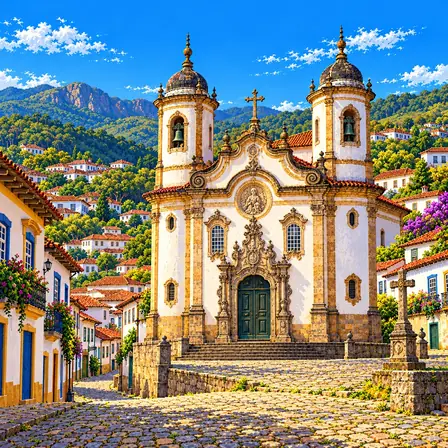
The Historic Town of Ouro Preto is an old town on steep hills. Old houses and churches line its stone streets. Its churches have carefully carved stone decorations.

The Historic Town of Ouro Preto lies on steep hills in southeastern Brazil. It grew around gold mining in the 18th century, and streets and buildings from Portuguese colonial rule remain. Its Baroque churches have curved decoration and intricate carvings. The Church of São Francisco de Assis shown here has ornaments carved in soapstone. The town was inscribed on the UNESCO World Heritage List in 1980 for its architecture and art.

Iguazu Falls
Nature

Iguazu Falls

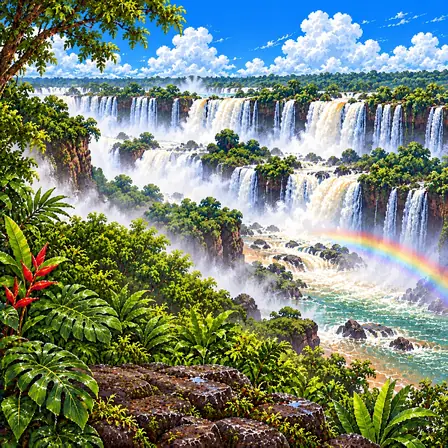
Iguazú Falls is a huge group of 275 waterfalls. It lies between Brazil and Argentina. From the Brazilian side, you can see all the falls at once.

Iguazu Falls, on the border of Brazil and Argentina, is the largest group of waterfalls in the world. The river wore down a basalt cliff formed by lava flows about 130 million years ago, spreading 275 waterfalls across 2.7 km. From the Brazilian side you can see the whole panorama of the falls, and from the Argentine side you can see the "Devil's Throat" up close. It is a UNESCO World Natural Heritage site in both countries.

Amazon Rainforest
Nature

Amazon Rainforest

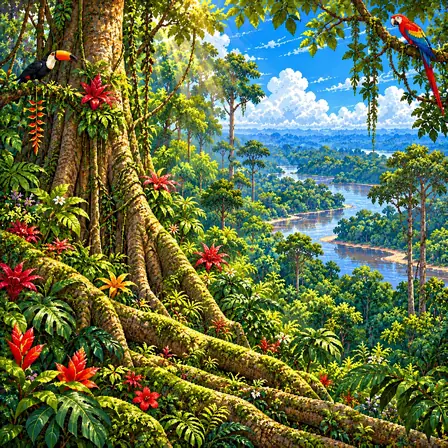
The Amazon rainforest is the biggest tropical forest in the world. More than half of it is in Brazil. Countless animals and plants live there together.

The Amazon Rainforest is the largest rainforest in the world, and about 60% of it is in Brazil. It is home to about 39,000 plant species, 1,300 bird species, and 3 million insect species. About 400 Indigenous tribes have lived alongside this ecosystem for thousands of years. The forest plays a key role in storing the Earth's carbon and cycling its rainfall, but about 20% of the forest has already been lost to clearing, seriously threatening the ecosystem.

Victoria Water Lily
Plants

Victoria Water Lily

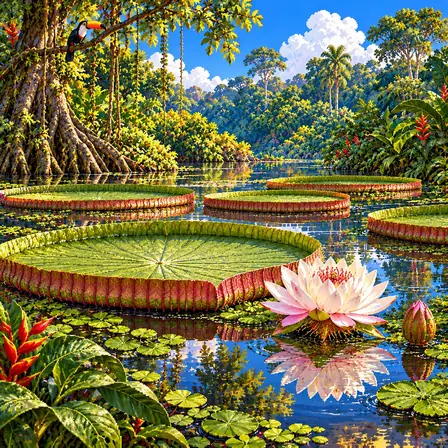
The Victoria water lily is a water plant with giant leaves. Its round leaves grow up to 3 m wide and float on the water. Its flowers open white at night and turn pink.

The Victoria water lily is a giant water plant you can see in the Amazon River basin of Brazil. Its round leaves grow up to 3 m across and float on the water, strong enough for a small child to stand on. Its cream-colored flower, which blooms only at night, turns pink over two days. It is a plant that stands for the rich ecosystem of the Amazon.

Samba & Carnival Costume
Culture

Samba & Carnival Costume

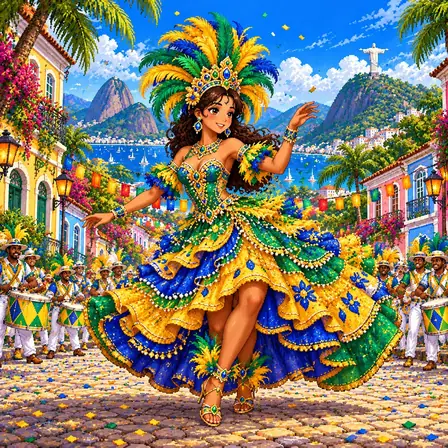
Carnival costumes are dazzling outfits decorated with feathers and sparkles. People wear them to dance to samba music. Huge crowds gather for the carnival in Rio de Janeiro.

The samba carnival costume is the colorful feathered outfit that dancers wear at Brazil's Rio Carnival. Samba is music and dance that blossomed in Brazil from rhythms that came across from Africa. During the carnival, teams called samba schools hold a parade contest with costumes and decorated floats they have prepared for a whole year. Held for five days around February each year, it fills the streets with about 2 million people. The playing of the bateria, a drum troop where hundreds beat drums at once, is the heart of the festival.

Feijoada
Food

Feijoada

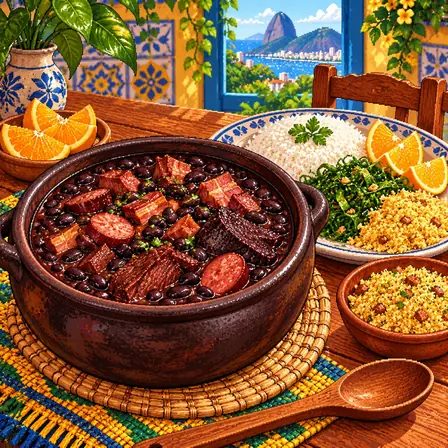
Feijoada is black beans and pork cooked for a long time. It is served with rice, sautéed greens and orange slices. Families enjoy it together for weekend lunch.

Feijoada is Brazil's best-known bean dish, made by simmering black beans and several cuts of pork in a big pot for a long time. It grew in Brazil from Portuguese bean cooking blended with African and Indigenous food cultures. Simmered for nearly four hours, its broth is thick and rich. It is served with white rice, sautéed kale, and fresh orange slices, and the orange cleanly washes away the richness. In Brazil there is a tradition of eating it usually for Wednesday and Saturday lunch.

Jaguar
Animals

Jaguar

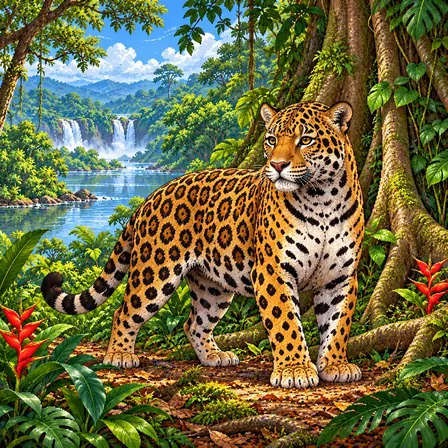
The jaguar is the biggest wild cat in the Americas. It is a great swimmer and can cross rivers. Its bite is strong enough to crack a turtle's shell.

The jaguar is the third largest member of the cat family after the tiger and the lion, and the largest beast on the American continent. It looks like a leopard, but you can tell them apart because it has extra dots inside its rose-shaped markings. Unlike most cats, it swims well, crossing rivers and even catching prey in the water. For its size, it has the strongest bite in the cat family, able to crack even a hard turtle shell. It is the top predator of the Amazon Rainforest, and as forests shrink, it has become a near threatened species in need of protection.
Olá
Greeting

Olá

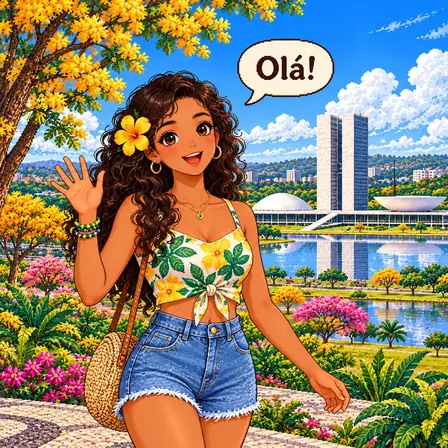
Olá means "hello" in Portuguese. Friends just say "Oi!" Brazil is the only country in South America that speaks Portuguese.

"Olá!" is read "oh-LAH," a Portuguese greeting. Among friends, people say a shorter, friendlier "Oi!" Brazil is the only country in South America that uses Portuguese. With more than 200 million people, most Portuguese speakers live in Brazil. Brazilian Portuguese is said to sound like singing, because the vowels are pronounced long and soft.

Brazil's Flag
Flag

Brazil's Flag

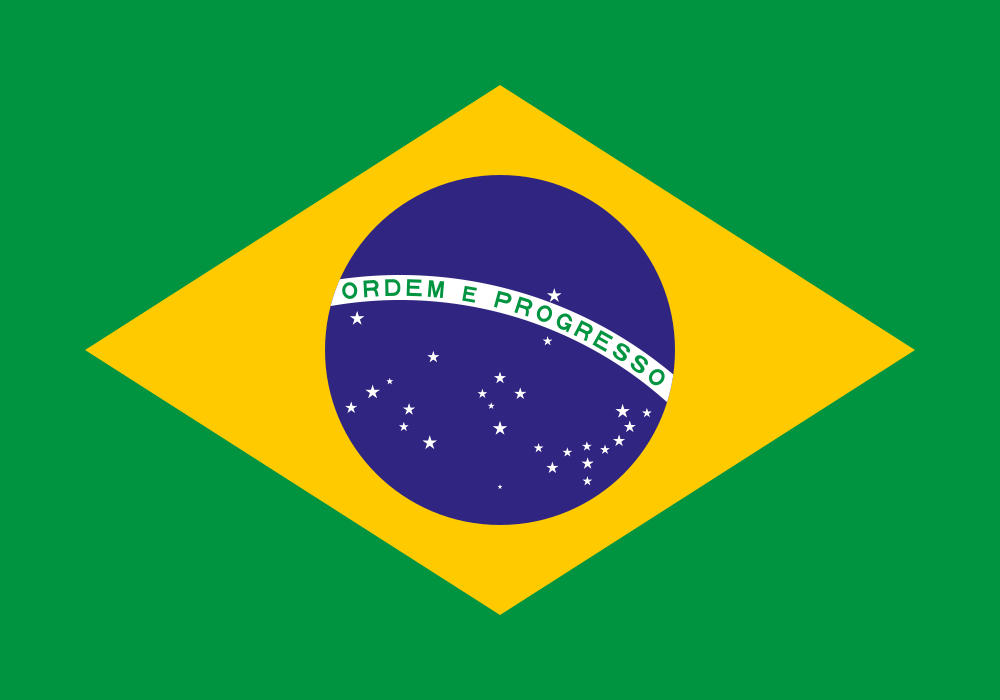
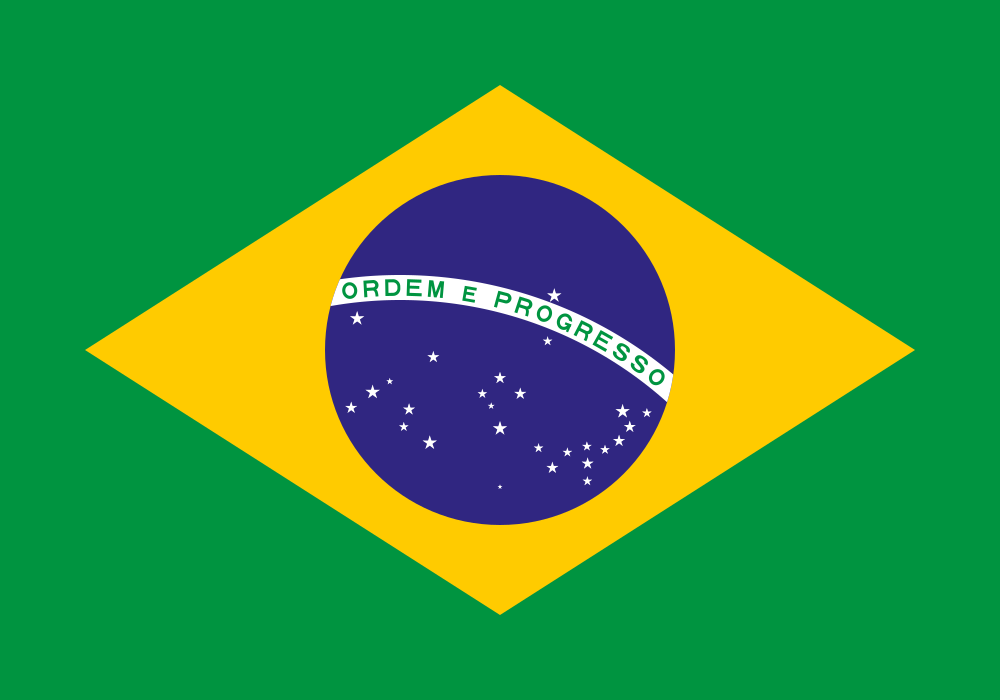
Brazil's flag has a yellow diamond on a green background. Inside the blue circle in the middle are 27 stars. The stars copy real constellations in the night sky.

Brazil's flag has a yellow diamond on a green field, with a blue circle full of stars inside it. On the blue circle are a band reading "Order and Progress" and 27 white stars. The 27 stars stand for Brazil's 26 states and its capital. The arrangement of the stars copies exactly the real star pattern in the sky over Rio de Janeiro on November 15, 1889. It is a special flag where you can find real constellations, like the Southern Cross, in the flag.